Water is the known source of life. However, it may also serve as a means of diversifying a portfolio.
Water is a commodity, much like gold and oil, and it’s becoming harder to get these days.
Thus, the water deficit presents investment possibilities just like any other scarcity.
Comprehending Water Investments
Water has an easy business case as it is one of the most valuable resources and will probably become much more limited in the future.
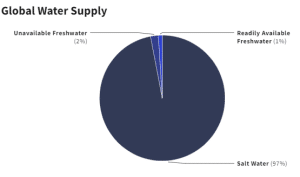
Over 97% of the water on Earth is salty, making up about 70% of the planet’s surface.
The majority of industrial applications, farming irrigation, and drinking are all prohibited by saltwater.
Just over 1% of the remaining 3% of global water resources are suitable for human use.
Global water scarcity is a result of both growing agricultural demand and rapid development.
China, Egypt, India, Israel, Pakistan, Mexico, much of Africa, and the United States (Arizona, New Mexico, California, and West Texas), to mention a few, have all had a shortage of H2O.
Furthermore emphasizing the necessity for clean water is pollution.
The effects of fertilizer runoff are shown by the dead zone along the Gulf Coast, and well water from California to Maryland contains methyl tertiary butyl ether (MTBE), an ingredient used in unleaded gasoline.
Evidence that pollution is not exclusive to the West comes from well-publicized occurrences that occurred abroad in China, Russia, and other places.
Naturally, the quantity of fresh water that is accessible for human consumption is further limited by contaminated water sources.
Open a Libertex Account to start trading and get a 100% welcome bonus today
Investment of $55 billion in clean water
President Biden enacted the Infrastructure Investment and Jobs Act on November 15, 2021. The $1.2 trillion in investment authorized by the bipartisan infrastructure plan includes $55 billion for the creation of clean drinking water, $65 billion for sustainable energy, and $21 billion for the cleanup of contaminated and dangerous sites.
The bill would increase access to clean drinking water for homes, companies, schools, and child care facilities in both urban and rural locations, which is wonderful news for those who support clean water. In order to remove lead service pipes, the Act will also invest in water infrastructure.
Indexes of Water Investment
The following are a few of the more well-liked indexes created to monitor different investment possibilities connected to water:
- The Dow Jones U.S. Water Index is a barometer made up of several local and foreign firms involved in the water industry with a minimum market capitalization of $150 million. It consists of around 29 stocks.
- Launched in December 2000, the ISE Clean Edge Water Index is a representation of firms that specialize in water-related solutions and includes companies in the areas of water distribution, water filtration, and flow technology. There are 35 stocks in it.
- A sub-sector of the Standard & Poor’s 1500 Utilities Index, the S&P 1500 Water Utilities Index consists of only two companies: Aqua America (NYSE: WTR) and American States Water (NYSE: AWR).
- The 50 firms that make up the S&P Global Water Index were added in 2001. Their water-related industries are divided into two categories: water utilities and infrastructure and water equipment and materials.
A further worldwide perspective on the water business may be obtained via the MSCI Global Sustainable Water Index.
The index is centered on established and up-and-coming businesses that get at least half of their income from sustainable water services and goods.
Some water equities are included in a number of utility indices as well.
2.3 billion
According to the United Nations, 2.3 billion people live in “water-stressed” nations, which means that they annually use more than 25% of their freshwater supplies. Water shortages might force 700 million people to relocate by 2030.
Investing in Water Securities: A Guide
Water-related industries may be profitable for beverage companies, utilities, water treatment/purification companies, and equipment manufacturers (e.g., pumps, valves, and desalination units).
An simple place to start your search for good investment options is to look at the holdings of any one of these water indexes.
Businesses vying for a slice of the water business range from small-cap Layne Christensen to blue-chip giant General Electric.
Aside from buying direct shares, several of the bigger companies provide dividend reinvestment programs.
International demand is increasing for bottled water. Following the surge in U.S. consumer demand, demand is increasing from China to Mexico.
According to estimates, the typical American consumes around 45 gallons of bottled water annually, and between 2010 and 2020, the country’s per-capita consumption of bottled water climbed by 61%.
177 nations depend on desalination to meet at least some of their freshwater consumption requirements, according a 2018 UN research.
If stock selection isn’t your thing, there are other ways to invest in water: mutual funds, exchange-traded funds (ETFs), and unit investment trusts (UITs).
The biggest is the Invesco Water Resource Portfolio ETF (PHO), which has 38 holdings as of February 2022, mostly mid- and small-capitalization enterprises and focused on the United States.
There is some exposure to equities connected to water via the iShares U.S. Utilities ETF (IDU).
Additional options include the First Trust ISE Water Index Fund (FIW) and the Invesco Global Water Portfolio ETF (PIO), which follows the Nasdaq OMX Global Water Index.
Popularity is progressively giving rise to other options.
The Allianz Global Water Fund makes investments to enhance the availability, effectiveness, and quality of water resource management.
It is benchmarked against the MSCI ACWI Index.
As a commodity, how can you invest in water?
Water futures are traded on the Chicago Mercantile Exchange and are linked to Californian water costs.
Through these futures contracts, investors may essentially speculate on the price of water in the future by wagering on the Nasdaq Veles California Water Index’s future value.
How Does Michael Burry Make Water Investments?
The Big Short ends with revelations that Michael Burry, the founder of Scion Capital, made investments in water after his profitable short sale.
Burry clarified in subsequently conducted interviews that “eating is the way to invest in water.”
That is, cultivate food in regions with plenty of water and transfer it to places with less water for sale.”
A farm in a region with a lot of precipitation is essentially betting on the future worth of water.
It could be simpler for individual investors to concentrate on water equities, however.
How Can Water Stocks Be Invested?
Stocks of businesses with a strong connection to the irrigation, utility, water treatment, or other water-related sectors are known as water stocks.
Investing in these may be done either purchasing individual company stocks or through purchasing an ETF or mutual fund that has a significant amount of exposure to water stocks.
Final Remarks
The demand for investments that benefit from the need for clean, fresh water has increased recently.
Investors may anticipate a plethora of new investments that expose them to this valuable commodity and the companies that provide it to the market if the trend keeps up.
These days, there are a ton of strategies to increase the amount of water exposure in your portfolio; most just take little research.
There are plenty of opportunities to invest in this limited resource.
Follow for the latest news and information Telegram Channel