Index trading allows you to estimate how the value of significant global stock market indexes will fluctuate. We’ll go over all you need to know about stock market index trading.
If this is your first time on our website, our team at Doughvest welcomes you. For the latest news and information, make sure you join ourTelegram Channel
Index trading allows you to estimate how the value of significant global stock market indexes will fluctuate. In this post, we’ll go over all you need to know about stock market index trading.
What is Index Trading?
Index trading involves purchasing and selling a basket of equities that make up a stock index. To put it another way, trading stock indexes frees you from dependency on a single company’s success and exposes you to the whole market. Index trading is one of the simplest methods to diversify your existing portfolio.
A stock index is a benchmark for the stock market’s performance, consisting of several equities established by rating agencies.
Consider S&P Global Ratings, previously known as Standard & Poor’s, the company behind the S&P 500 and Dow Jones Industrial Average (Dow 30 Index). This method is one of the most straightforward ways for traders to assess “the economy” as a whole.
For example, the S&P 500 index, which tracks the stock performance of 500 publicly traded businesses listed on US stock exchanges, is available for day trading and is regarded as a key indicator of the US economy. Similarly, the DAX 30, a stock market index, is used to assess the performance of the top 30 German blue-chip businesses listed on the Frankfurt Stock Exchange.
In addition to the US stock market indices, there are now national stock market indices all over the globe.
- European stock market index (DAX 30 index in Germany, FTSE 100 index in the UK)
- Stock market index India (Nifty 50)
- China equity market index (Shanghai SE Composite Index)
The Euro Stoxx 50 Index and the MSCI World Index are examples of regional stock market indices; the other stock market indices are worldwide in scope.
It is not feasible to directly purchase stock indexes since an index is only a baseline. While our first choice for index trading is exchange-traded funds (ETFs), futures and options contracts provide a practical means to begin trading equities.
How is a Stock Index Calculated?
To understand how a stock index is calculated, you must be familiar with the various types of stock market indexes, which include:
- Market Value-Weighted Index: (Equities with higher market capitalization weight smaller enterprises more heavily). S&P 500 is one example of a market value-weighted index.
- Price-Weighted Index: The index is computed using the stock price rather than market capitalization. The Dow Jones Industrial is a price-weighted index, for example.
We will demonstrate the calculation of the S&P 500 index value as an example.
Each component in the S&P 500 stock index has a certain percentage weight in its composition.

The value of the S&P 500 index is calculated using the following mathematical formula:
Index Level = Dividend ∑i = 1nIWFi × Pi × Shares
Where:
Pi = price.
Equal weighting percentage=IWF
How to Trade in Index?
We’ll look at our forecasts for the stock index market’s future movement.
Based on our examination of historical stock index prices, we will devise a few stock index trading techniques.
Understanding how the stock market normally operates is required before understanding how to trade the index.
The stock market normally increases smoothly, but there are sometimes major declines in stock indexes, which may lead to a recession or even a depression. However, even in a low market, there will be several opportunities for profit. Learn how to trade stocks amid a slump.
- The bullish cycle in the stock market is characterized by steady, moderate price increases.
- In contrast to the bearish stock market cycle, which is characterized by a sharp decline in prices.
According to the proverb:
“The stock market goes up the stairs and down the elevator.”
In light of this, we may use a variety of stock market index trading methods based on intraday charts and intermediate time frames. If you can learn to spot these frequent stock index patterns, you will be able to trade confidently on the world’s major trading marketplaces.
Traders from all across the globe often query us:
“How should I trade stocks using an index?”
What is the most effective trading technique for the S&P 500, Dow 30, DAX, and Nifty 30?
As previously stated, all stock indexes display identical price behavior.
When we get queries like these, we tell customers not to attempt to forecast a peak in a bullish market cycle. Nonetheless, don’t attempt to time the bottom of a stock market downturn.
Only inexperienced traders would attempt to short an up trending market if it became too high or overbought. However, good traders often show a little more tolerance.
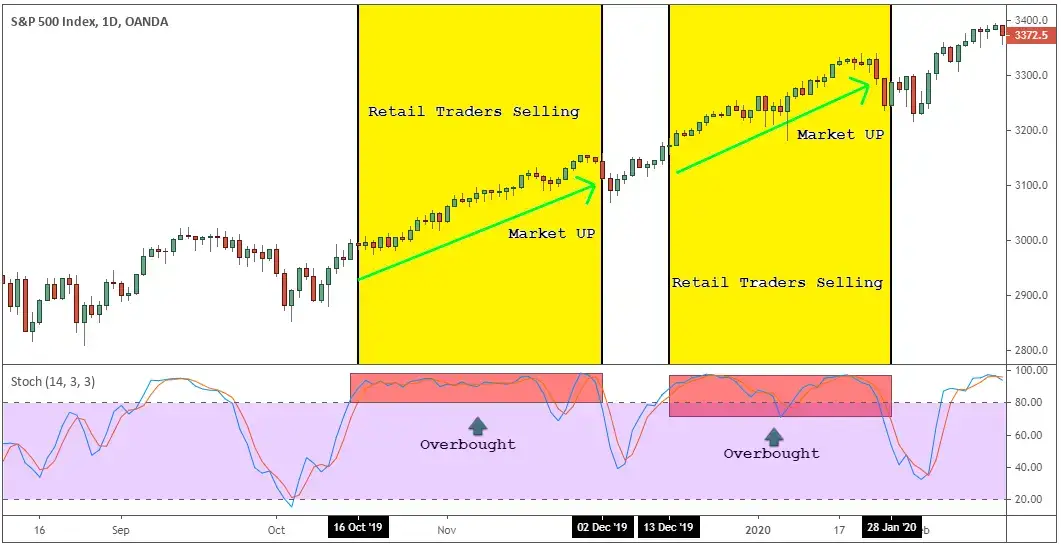
Although markets may become overheated and a large correction is looming, the overall direction of the stock market remains good in the long term. Technical trading indicators may help you determine the direction of a trend.
Tired of losing trades? Open a Libertex account to start trading stocks and forex with the professionals today.
Stock Market Index Trading Strategies
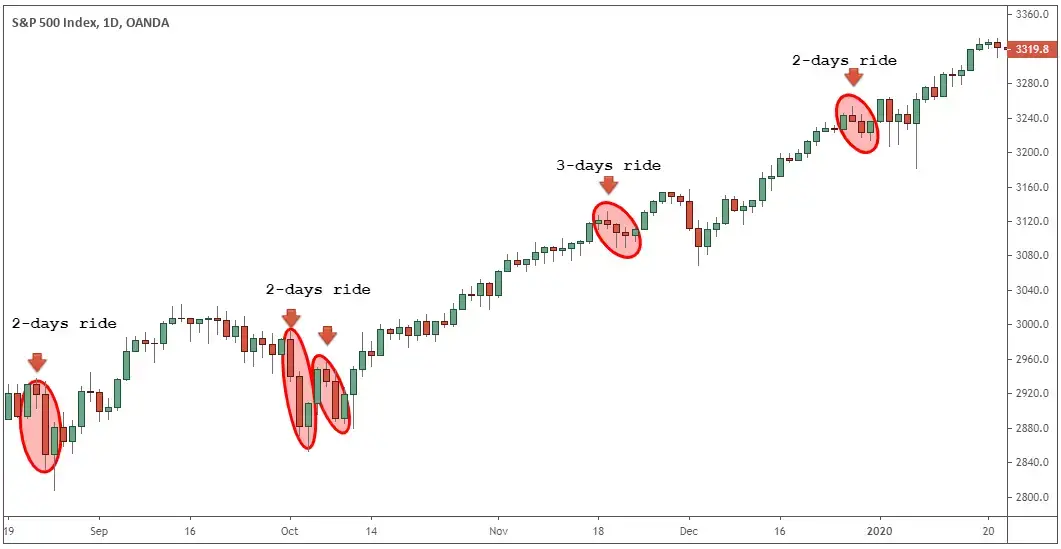
1.The 3-day drive to buy pullbacks
How can we buy a long-term stock index?
Our basic trading strategy is to purchase the market just as it is about to retreat. Even while this method is not completely infallible, it might be rather beneficial.
Based on our analysis of stock index performance, we observed that pullbacks typically last three days.
To purchase an index of shares, follow the setup trading recommendations:
- Wait until each day has three (or two) red candles.
- Keep a watch out for a retraction on the third or fourth day.
- If the market breaks below the third-day low on the fourth day, wait for it to rebound above the fourth-day open price.
Below is a chart of S&P500 index
2. On the downside, sell with negative momentum
Purchasing and selling stock indexes are distinct procedures.
Generally, we like to come late for short events and early for longer ones.
We are more likely to purchase stock indexes during periods of downturn. Because the stock market has a greater tendency to rise over time, it is safer to expect that it will return even after a little decline.
If we utilize a short index strategy, we will sell the stock market when we see signs of weakness.
For example, if a stock index falls and there is sustained selling pressure, we seek for short trading chances on the downside.
Selling stock indices when the market is starting to fall and displaying the lower highs and lower lows of the downtrend price structure is a safer approach than trying to sell them when the market is gaining.
Let’s look at how stock index trading may be done in reaction to important news announcements. Mergers, new trade agreements, investments, scandals, and other events may cause dramatic changes in a stock index.
Consider utilizing a trading calendar to help you forecast when the most important news will be released.
3.News-based trading
News-based trading events may be devastating without a defined strategy since news often causes huge market changes.
Among the major announcements that prompted the market to move were:
US Federal Reserve (FED) meetings.
US job statistics and unemployment rate (NFP report).
as well as any news that has a significant influence on the stock market’s pricing.
In terms of news trading, we wait for the dust to settle before taking positions based on the market’s reaction.
If the market swings as a consequence of major news and the price closes at an extreme that day (we want the index price to be at the day’s high or low), we often witness a follow-up the next day in the same direction.
In Conclusion
Finally, adopting the best index trading approach is regarded as a reliable way to invest your money. To succeed, avoid predicting peaks during uptrends and instead learn to ride troughs, leaving the trade if you’re incorrect and keeping on if you’re right.
Buying stock indexes at a low price is a better long-term investment than attempting to sell a rising market. Technical indicators are another method for purchasing stocks.
When it comes to index trading, you must choose the right index instrument and contracts based on your account size and risk tolerance.
Follow for the latest news and informationTelegram Channel