As of September 30, 2022, there are a total of 503 stocks trading on the New York Stock Exchange (NYSE) that represent the 500 companies that make up the S&P 500 because some companies, like Alphabet, have issued multiple classes of shares.
S&P Global provides a list of their top 10 holdings on their official website. To be included in the S&P 500, a company must fulfill certain criteria.
The complete list of holdings, however, is not available from S&P at this time, at least not without paying a fee. The entire list is available to subscribers of S&P Capital IQ, a research arm of S&P.
The S&P 500 is a benchmark of the American economy because it includes the 500 largest publicly traded companies in the United States.
Get to buy and trade stocks, currencies, crypto on Libertex and get a 100% welcome bonus today (bonus applies to stocks ONLY)
KEY PHRASES
- For an indication of the state of the American economy, look no further than the S&P 500, which features some of the most successful corporations in the country.
- Prior to being included in the S&P, a company must first meet certain requirements established by the index’s creators.
- Since the S&P 500 is weighted by market capitalization, the larger companies receive a larger share of the index’s total value.
- Among the requirements for inclusion in the S&P 500 are a market capitalization of at least $14.6 billion and a public float of at least 10% of shares outstanding.
- In the event of significant deviation from these criteria, companies’ inclusion in the S&P 500 may be revoked.
Qualifications for the S&P 500
One of the most widely referenced stock market indices, the S&P 500 was launched in 1957. Companies listed on the S&P 500 index are among the largest in the United States that are open to the investing public.
The large-cap segment of the American market is the S&P 500’s primary focus. To be included in the S&P 500, a company must satisfy many requirements.
- A total market capitalization of at least $14.6 billion
- Must be a U.S. company
- Must have a public float of at least 10% of its equity shares outstanding
- A positive sum of the most recent four consecutive quarters of trailing earnings
- Positive earnings for its most recent quarter
- Must meet certain liquidity requirements
If a company significantly deviates from these criteria, it may be removed from the S&P 500.
$31 Trillion
The combined market cap of all the stocks in the S&P 500 index’s value on September 30, 2022.
S&P 500 Calculation

Image source: Libertex
The S&P 500 is a capitalization-weighted index that includes all publicly traded companies.
The dollar value at which a company’s outstanding equity shares trade is what is known as its “market capitalization,” or “market cap.”
To determine market capitalization, take the current stock price of the company and multiply it by the number of outstanding shares of stock.
If a company has 20,000,000 outstanding shares and its stock price is $100 per share, then its market cap is $2,000,000,000.
Therefore, the greater the increase in value of a given company’s stock, the greater its weight in the S&P 500’s total return. Three-quarters of an index’s return may be tied to as few as fifty to seventy-five stocks.
Therefore, changes to the index that include the addition or removal of smaller companies will have minimal effect on the index’s overall return, while changes that involve the removal or addition of even a single large stock can have a material effect.
Market Segmentation of the S&P 500
On September 30, 2022, the following sectors and their respective weights in the S&P 500 index were determined.
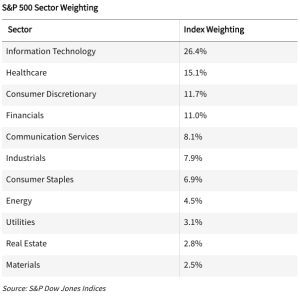
If you want to know how much an outperforming or underperforming sector contributes to the value of the S&P 500, you need to know how heavily it is weighted in the index.
If oil prices are rising and the energy sector is reaping the benefits, for instance, only 4.5% of the S&P 500 is invested in energy stocks.
Therefore, oil stocks may not result in a higher S&P if the more heavily weighted information technology sector is underperforming.
IMPORTANT
Market Cap of the top 25 components
Because S&P does not disclose its top 25 components’ individual weights, the following weights were derived from the SPDR S&P 500 Trust ETF (SPY).
As of October 10, 2022, SPY, the oldest exchange traded fund (ETF) tracking the S&P 500, had over $326 billion in AUM and saw heavy trading volume.
Information is power. Click to know the basics about shares and how you can buy them
Consequently, investing in SPY is similar to investing in the underlying S&P 500 index due to the weightings of its portfolio. Here are the 25 most heavily weighted stocks in the S&P 500 index as of October 10, 2022.
- Apple (AAPL): 6.99%
- Microsoft (MSFT): 5.63%
- Amazon (AMZN): 3.32%
- Tesla (TSLA): 1.96%
- Alphabet Class A (GOOGL): 1.93%
- Alphabet Class C (GOOG): 1.71%
- Berkshire Hathaway Class B (BRK.B): 1.59%
- UnitedHealth Group (UNH): 1.54%
- Johnson & Johnson (JNJ): 1.39%
- Exxon Mobil (XOM): 1.36%
- JPMorgan Chase (JPM): 1.01%
- Meta (META), formerly Facebook, Class A: 1.01%
- Visa Class A (V): 0.98%
- Procter & Gamble (PG): 0.97%
- NVIDIA (NVDA): 0.96%
- Home Depot (HD): 0.96%
- Chevron Corporation (CVX): 0.93%
- Eli Lilly (LLY): 0.84%
- Mastercard Inc. Class A (MA): 0.82%
- AbbVie Inc. (ABBV): 0.81%
- Pfizer (PFE): 0.77%
- Merck (MRK): 0.76%
- PepsiCo (PEP): 0.73%
- Bank of America (BAC): 0.71%
- Coca-Cola Company (KO): 0.70%
How Many Firms Make Up the S&P 500 Index?
The S&P 500 index includes 500 companies; however, as of September 30, 2022, there are 503 stocks because some companies, like Alphabet, have multiple classes of equity shares.
How Do Companies Make It onto the S&P 500?
There are criteria that must be met before a company can be considered for the S&P 500.
- A market cap of at least $14.6 billion
- Must be a U.S. company
- Company’s stock must have a public float of at least 10% of its outstanding equity shares
- Positive earnings over the most recent four consecutive quarters summed together
- A profitable earnings report for the company’s most recent quarter
- Liquidity requirements
How to Buy the S&P 500
As an index, the S&P 500 cannot be bought directly. However, exchange traded funds (ETFs) that mimic or track the index can be purchased, such as the SPDR S&P 500 Trust ETF offered by State Street Global Advisors (SPY).
Conclusion
The S&P 500’s top 25 companies include some of the most recognizable brands in the world. The top 10 are dominated by technology giants like Apple, Microsoft, and Google. One can buy stocks from the companies included in the index directly or invest in a fund that follows the S&P 500.
Follow for the latest news and information Telegram Channel