

The Russell 2000 Index: What is it?
A stock market index called the Russell 2000 Index evaluates the performance of the 2,000 smaller businesses that make up the Russell 3000 Index.
Because of its emphasis on smaller businesses in the American market, London’s FTSE Russell Group, which oversees the Russell 2000, is sometimes seen as a barometer of the American economy.
KEY POINTS
- The Russell 2000 index comprises 2,000 small-cap businesses and is a market index.
- The Frank Russell Company introduced the index in 1984, and FTSE Russell now oversees its management.
- A common benchmark for evaluating the performance of small-cap mutual funds is the index.
- Many investors believe that the index’s wider scope gives it a competitive advantage versus smaller-cap stock indices.
- Investing in a fund that follows the index allows investors to mimic the results of the Russell 2000 Index.
Comprehending the Russell 2000 Index
The Frank Russell Company established the Russell 2000 Index in 1984.
The London Stock Exchange (LSE) Group subsidiary FTSE Russell is in charge of managing this American index.
There are around 2,000 small-cap firms in the index.
The index is the most often cited indicator of small- to mid-cap companies’ overall performance.
It consists of the lowest two-thirds of the Russell 3000 index in terms of business size, accounting for around 7% of the index’s total market capitalization.
The movements of almost 96% of all publicly listed U.S. equities are reflected in the broader index.
The top three holdings in the index as per FTSE Russell’s index factsheet dated March 31, 2024, were Comfort Systems USA (FIX), Microstrategy (MSTR), and Super Micro Computer (SMCI).
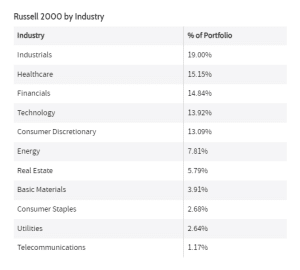
The industries with the highest weighting are industrials, healthcare, and financials. An overview of the index’s industry split is provided in the table below.
Open a Libertex Account to start trading and get a 100% welcome bonus today
The Russell 2000 Index is preferred by investors in mutual funds because it captures the investment opportunity afforded by the whole market, as opposed to opportunities provided by smaller indexes that can have bias or higher stock-specific risk, which might skew the performance of a fund manager.
It should come as no surprise that the Russell 2000 serves as the model for Mutual funds and exchange-traded funds (ETFs).
Crucial: A lot of investors contrast the performance of small-cap mutual funds with that of the index. This is so because, unlike smaller indexes that can have biases or more stock-specific risks that might skew performance, the movement of the index is thought to represent the opportunities in that whole market segment.
Important Russell 2000 Index Metrics
The median market capitalization was $960 million as of March 31, 2024, while the average value of a firm on the Russell 2000 was $4.82 billion.
$58.43 billion was the market capitalization of the biggest stock in the index.
On May 20, 2013, the Russell 2000 crossed 1,000 for the first time.
To monitor the success of the Russell 2000’s firms with distinctive qualities that appeal to certain investor groups, two sub-indices have been developed:
The performance of Russell 2000 firms with greater price-to-value ratios and higher projected growth values is gauged by the Russell 2000 Growth Index.
The performance of Russell 2000 firms with lower price-to-book (P/B) ratios and lower projected growth values is measured by the Russell 2000 Value Index.
Quick Fact: The Russell 1000 Microcap Index consists of the 1,000 smallest firms in the Russell 2000. The two thousand smallest firms in the larger Russell 3000 Index make up the Russell 2000.
Particular Points to Remember
Market capitalization and the various indices that a company is listed on are combined to determine the weighting of the Russell 2000 Index.
This implies that a member stock’s listing on the index is influenced by its latest selling price, the quantity of shares that may be exchanged, and whether or not it is included in other indexes.
Tracking small-cap companies sets the Russell 2000 apart from other major indexes in yet another significant way.
Conversely, the Dow Jones Industrial Average (DJIA) and S&P 500 indexes follow large-cap firms.
Investors that take the time to build a large, intricate portfolio that closely resembles the index may mimic the returns of the index.
Still, there are many simpler methods to achieve the same results.
Investors may employ index-based mutual funds that follow the Russell 2000, or index futures.
An ETF is the most often used choice. The iShares Russell 2000 index ETF (IWM) is the most actively traded ETF.
What Is Shown by the Russell 2000?
The performance of 2,000 publicly listed small-cap U.S. firms is gauged by the Russell 2000 Index.
The Russell 2000 Methodology: What Is It?
A float-adjusted market capitalization method is used by the Russell 2000 to evaluate small-cap U.S. companies.
What Is the Russel 2000’s All-Time High?
On November 7, 2021, the Russell 2000 hit a high of 2,458.
The Final Word
Introduced in 1984, the Russell 2000 is an index comprising 2,000 small-cap firms.
As a benchmark for American small-cap equities, it is extensively used.
Roughly 98% of the publicly listed equities in the United States are included in the Russell 3000, which includes 2,000 of the smallest businesses in the index.
Every June, the Russell 2000 is rebalanced, and businesses are added, removed, or retained.
Follow for the latest news and information Telegram Channel



