Introduction
In trading, losses are unavoidable. Even the most successful traders in the world experience losing trades, losing days, and sometimes extended losing streaks. What separates consistently profitable traders from those who eventually blow their accounts is not the absence of losses, but how well they manage drawdowns.
Drawdown management is one of the most overlooked yet most critical skills in trading. Many traders focus heavily on entries, indicators, and strategies, but fail to plan for what happens when the market goes against them. Without proper drawdown control, even a profitable strategy can fail.
This article explains what drawdown is, why it matters, and practical strategies traders can use to survive losing periods and protect both their capital and psychology.
What Is Drawdown in Trading?
A drawdown refers to the decline in your trading account from its highest point (equity peak) to a lower value due to losses. It is commonly expressed as a percentage.
For example:
- If your account grows from $10,000 to $10,400 and then falls to $9,700, the difference between the peak and the current balance represents your drawdown.
- A drop from $10,000 to $9,000 equals a 10% drawdown.
Drawdown does not mean you are a bad trader. It simply reflects normal fluctuations in performance. However, how deep the drawdown becomes determines how difficult it will be to recover.
Understanding Drawdown Through an Illustrative Chart
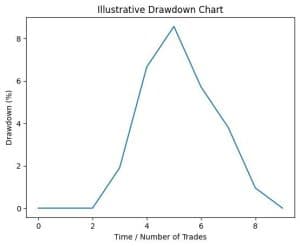
A drawdown chart visually shows how losses develop relative to your account’s previous highs. Instead of focusing on balance alone, it tracks how far the account falls below its peak over time.
In a typical drawdown chart:
- The horizontal axis represents time or number of trades.
- The vertical axis represents drawdown percentage.
- When the line rises, the account is moving further away from its equity peak.
- When the line falls, the account is recovering.
- A drawdown of 0% means a new equity high has been reached.
This type of chart highlights an important truth: losses often come in clusters, not evenly spaced. It also shows that recovery usually takes longer than the decline itself. This is why managing drawdowns early is far more effective than trying to recover from deep losses later.
Why Drawdown Management Is Critical
Many traders underestimate how difficult recovery becomes after a large drawdown:
- A 10% drawdown requires about an 11% gain to recover.
- A 30% drawdown requires roughly a 43% gain.
- A 50% drawdown requires a 100% gain just to break even.
The deeper the drawdown, the more pressure it places on your psychology, often leading to emotional trading, overtrading, and rule breaking. Proper drawdown management helps you stay consistent, disciplined, and focused on long-term growth.
Tired of losing trades? Open a Libertex account to start trading stocks and forex with the professionals today.
1. Use Proper Risk Per Trade
The foundation of drawdown management is risk control. Professional traders typically risk no more than 1–2% of their account per trade.
For example:
- With a $10,000 account, risking 1% means risking $100 per trade.
- Even after several consecutive losses, the drawdown remains manageable.
Small, controlled losses prevent sharp spikes in the drawdown curve and make recovery smoother.
2. Set Maximum Daily and Weekly Loss Limits
Loss limits act as a safety brake. By defining how much you are willing to lose in a day or week, you prevent emotional decision-making.
Common rules include:
- Stop trading for the day after a 2–3% loss.
- Stop trading for the week after a 6–8% loss.
These limits flatten the drawdown curve and protect your account from revenge trading.
3. Reduce Position Size During Drawdowns
When the drawdown chart starts rising consistently, it is a signal to reduce exposure. Instead of stopping completely, many professionals reduce their risk per trade.
For instance:
- Reduce risk from 2% to 0.5–1% during losing periods.
This slows the rate of drawdown while allowing you to stay engaged and refine execution.
4. Avoid Overtrading
Overtrading is one of the fastest ways to deepen a drawdown. After losses, traders often feel pressure to recover quickly, leading to impulsive trades and poor setups.
Effective drawdown management means:
- Trading only high-probability setups
- Respecting session limits
- Accepting that some days are not ideal for trading
Remember, not trading is also a position.
5. Review Your Trading Journal
Drawdowns provide valuable information. A journal helps you identify whether losses are due to:
- Market conditions
- Strategy weaknesses
- Emotional or execution errors
Many drawdowns occur not because a strategy stopped working, but because discipline weakened.
6. Adapt to Market Conditions
Every strategy performs differently across market environments. Trending strategies struggle in ranges, while scalping strategies may fail during low volatility.
Recognizing market shifts allows you to:
- Reduce trade frequency
- Adjust expectations
- Avoid unnecessary losses
This adaptability keeps drawdowns shallow and controlled.
7. Protect Your Mental Capital
Drawdowns affect psychology more than balance. Fear, frustration, and self-doubt can damage decision-making faster than losses themselves.
To protect mental capital:
- Take short breaks after losing streaks
- Focus on execution quality, not profit
- Use drawdown charts to view losses objectively
A calm mindset leads to better recovery.
Final Thoughts
Drawdowns are a natural part of trading, not a sign of failure. What defines long-term success is how well you manage them. By controlling risk, setting loss limits, adjusting position size, and understanding drawdown behavior through charts, traders give themselves a real chance to survive and grow.
Trading is not about winning every trade. It is about protecting capital, staying disciplined, and remaining consistent long enough for your edge to play out. Master drawdown management, and you master one of the most important skills in trading.
Thank you for taking the time to read. Follow for the latest news and information.telegram