

Gold is regarded as a secure investment. It is intended to serve as a secure sanctuary during periods of market decline, as the price of gold generally does not fluctuate in accordance with market prices.
Consequently, gold may be regarded as a hazardous investment, as history has demonstrated that the price of gold does not always increase, particularly during periods of market expansion.
If the market is characterized by dread and investors anticipate that stock prices will decline, they frequently turn to gold.
Additionally, gold is not typically an asset that generates income, although there are a few gold instruments.
In contrast to equities and bonds, the return on gold is typically entirely determined by price appreciation.
Additionally, gold investments incur distinctive expenses. Storage and insurance expenses are necessitated due to its tangible nature.
Additionally, gold is generally perceived as a secure asset; however, it is capable of experiencing significant price fluctuations.
Gold is most effective when it serves as a hedge against a declining stock market, taking into account these factors. Let us examine the long-term performance of gold.
KEY POINTS
- Gold has historically been a safe haven against inflation.
Stocks and bonds have outperformed gold throughout time. - Gold may win in shorter timeframes.
- Gold rises under rising inflation and geopolitical turmoil.
- Gold hit an all-time high of over $2,089 in 2020 during the COVID-19 epidemic, and it rose beyond $2,000 again in early 2022 during the Russia-Ukraine war.
Gold vs. Stocks and Bonds
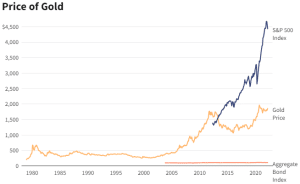
The efficacy of gold as an investment over the long term is contingent upon the time period under analysis.
For instance, stocks have outperformed gold and bonds over specific 30-year periods, while gold has outperformed both stocks and bonds over specific 15-year periods.
The price of gold increased by approximately 360% between 1990 and 2020.
The Dow Jones Industrial Average (DJIA) experienced a 991% increase during the same time frame.
The price of gold increased by 330% over the 15-year period from 2005 to 2020, which is approximately equivalent to the 30 years that were previously examined.
The DJIA experienced a mere 164% growth during the same time frame.
Therefore, stocks appear to outperform gold by approximately three-to-one in the long term; however, gold may prevail over shorter time frames.
In fact, stock returns surpass gold in terms of value when we examine the period from the 1920s to the present.
Open a Libertex Account to start trading Commodities and get a 100% welcome bonus today
$2,089
During the COVID-19 pandemic in August 2020, gold attained an all-time high of $2,089 per ounce before experiencing a decline. In March 2022, it once again surpassed $2,000 in response to the Russian invasion of Ukraine. It eventually surpassed the 2020 high in March 2024.
Turning to bonds, the average annual rate of return on investment-grade corporate bonds from the 1920s to 2020 is approximately 5%.
This suggests that, comparable to gold, corporate bonds have returned approximately 330% over the past three decades.
The return on bonds has been lower than that of both equities and gold over a 15-year period.
A Historical Perspective
The price of gold was effectively fixed at $35 per ounce from January 1934, when the Gold Reserve Act was introduced, to August 1971, when President Richard Nixon closed the U.S. gold purchase window, in order to obtain a historical perspective on gold prices.
President Franklin D. Roosevelt had insisted that citizens exchange gold bullion, coinage, and notes for U.S. currencies before the Gold Reserve Act was enacted.
This effectively rendered investing in gold extremely challenging, if not impossible and futile, for those who were able to accumulate or conceal significant quantities of the precious metal.
A price appreciation of approximately 5,700% for gold can be calculated by utilizing the set gold price of $35 and the price of $2,000 per ounce as of the first quarter (Q1) of 2022.
The DJIA has experienced a value increase of approximately 3874% from 1971 to Q1 2022.
What is the average return on gold investments?
The return on gold is contingent upon the time period in question.
Gold experienced an average annual return of 10.6% from January 1971, when the dollar was decoupled from gold, to December 2019.
During the same time frame, global stocks experienced an 11.3% increase. In 2023, the average annual return on gold was 13.8%.
What is the reason for the decrease in investment in gold during periods of elevated stock returns?
In general, gold exhibits relatively weak performance during periods of bull market equities.
One explanation is that gold is not an asset that generates income or represents development in a specific industry or company.
Rather, it is regarded as valuable due to its sociohistorical precedent and relative scarcity.
Consequently, equities are more appealing to investors when the economy is expanding and corporations are performing well.
Is gold outperformed by cryptocurrency?
Bitcoin (BTC) has significantly outperformed the majority of asset classes, including gold, since its inception in 2009.
It has increased from less than $1 to several thousands of dollars.
Bitcoin and other cryptocurrencies have been likened to a form of digital gold by many due to their scarcity and the fixed and diminishing rate of new supply.
Nevertheless, gold has outperformed cryptocurrencies over a limited period of time, such as the past two years.
This is primarily attributable to the decline market that affected Bitcoin and other cryptocurrencies in 2022.
In conclusion,
As with any investment, it is crucial to evaluate the time frame of the investment and conduct market research to gain insight into the anticipated performance of the markets.
The price of gold is not a guaranteed investment, as it is subject to fluctuations in response to a variety of global economic factors, as is the case with equities and bonds.
Diversification is crucial for all investment portfolios, and gold investments can contribute to portfolio diversification.
This is particularly crucial during market downturns, as the price of gold frequently rises.
Follow for the latest news and information Telegram Channel



