This trading approach will demonstrate the advantages and power of trading a single stock. You may discover how to get rich by concentrating on only one stock and using this single-stock trading approach.
Though carefully selecting individual stocks might reduce the risk involved with stock investment, it remains a risk.
If this is your first time on our website, our team at Doughvest welcomes you.
Introduction
What amount of stock should one trade?
The best course of action for someone just starting out in stock trading is generally to concentrate on a single stock.
Avoid becoming a “master of none, jack of all trades.”
Switching between equities or trading signals. You will not succeed if you attempt to time the price movement of many shares at once.
Even the best athletes in the world gain significantly from consistent practice. They practice their routine by repeating the same job every day. Repeating a single action leads to success. Similarly, learning to trade a single stock leads to success.
First, let’s go over the process of buying individual stocks, and then I’ll explain why trading individual stocks works best when paired with day trading strategies.
How do I buy single stocks?
The technique for investing in single stocks is identical to that for trading any other financial asset. This is a thorough instruction on how to buy certain stocks:
First, set up a stock-trading account.
Step 2: Research the stock you wish to buy. Step 3: Determine your investment threshold for that stock.
Step 4: Choose the appropriate order type. Step 5: Manage your inventories carefully.
You may boost your chances of success by minimizing risk and approaching stock trading with a trading plan.
Pros and Cons of Single Trading
Each stock has a unique swing due to variables such as book inventory and liquidity. No two stocks will move in the same manner in this regard. This means that in order to evaluate the movement of the stock price, you must trade each stock independently and using a range of instruments.
Perhaps you’ve found yourself in a scenario where one stock is responsible for the bulk of your transactions and profits.
If this is true, you are very wealthy.
Let me explain.
Your psychological state plays an important role in your performance as a stock trader. Furthermore, our subconscious stores the vast bulk of the information that our brains absorb. These are the things we aren’t consciously aware of.
We underestimate how effective our subconscious is at internalizing knowledge. Thus, it’s likely that our subconscious is better at identifying trading opportunities in the stock ticker for Apple, Amazon, or another firm.
If trading the share price of a single stock is the source of all of your stock profits, abandon everything else and focus only on that stock.
Invest in a single stock and watch it develop until it brings you a fortune!
How many stocks do NYSE specialists trade?
It is a simple answer to…
There’s just one stock!
Why do New York stock specialists focus on only one market? They have been in charge of the stock market for many years and seldom have a lost day. I hope you see how single-stock trading and profitability are connected.
If you trade stocks every day for the rest of your life, you will undoubtedly become an expert. It sounds better today to invest all of your money in one stock.
Single-stock trading gives the following additional benefits:
- The time spent on stock selection and screening will be reduced.
- In trading, you will use a focused approach.
However, trading just one stock has the major disadvantage of causing you to miss important movements in other stocks. Even if you trade many shares at once, the same thing might happen.
How much should you invest in a single stock?
If you don’t know how much to invest in a single stock, you should find out right away.
You must first define your goals.
- Do you plan to make stock investments?
- Or do you plan to participate in active stock market trading?
The most frequent error stock investors make when investing in stocks is placing too little or too much money in one company.
So, how many shares of a single stock should you buy?
The obvious reason is related to your available funds for stock investing. Before putting your hard-earned money in danger, be sure you understand how to invest in individual stocks.
However, if you wish to actively trade particular firms, day trading stocks is best done at a risk of little more than 2%.
If you have a small account (less than $25,000), be sure you understand the Pattern Day Trading Rules.
The 2% risk rule is the most popular investment strategy among Wall Street experts. Stock traders who follow the 2% risk rule may accomplish two objectives:
reducing the amount of loss.
You are capable of enduring a long losing run.
Just now…
We will provide our one stock trading strategy together with the three basic trading philosophies.
Tired of losing trades? Open a Libertex account to start trading stocks and forex with the professionals today.
Single Stock Trading Strategy
Before you can utilize the single-stock trading technique, you must first pick the stock you will trade. If you don’t already have a favorite stock to trade, you’ll need one that can generate money on an intraday basis in order to make a profit.
The most important thing for a stock day trader is to understand which equities to trade.
You could be asking yourself now, what
What is the best approach to choosing stocks for lucrative day trading?
For stock selection during day trading, just utilize these three trading principles:
- Choose a highly liquid stock.
- Choose a very volatile stock.
- Become an expert in a single trading setup.
- If you could only buy one stock, think about your alternatives and why you chose it.
Once you’ve determined that, it’s time to begin studying the price action of that particular stock.
It is critical that you properly grasp your inventory.
Without further ado, let us talk about how to trade your favorite stock in less than an hour.
Opening Bell: How Skilled Professionals Should Trade
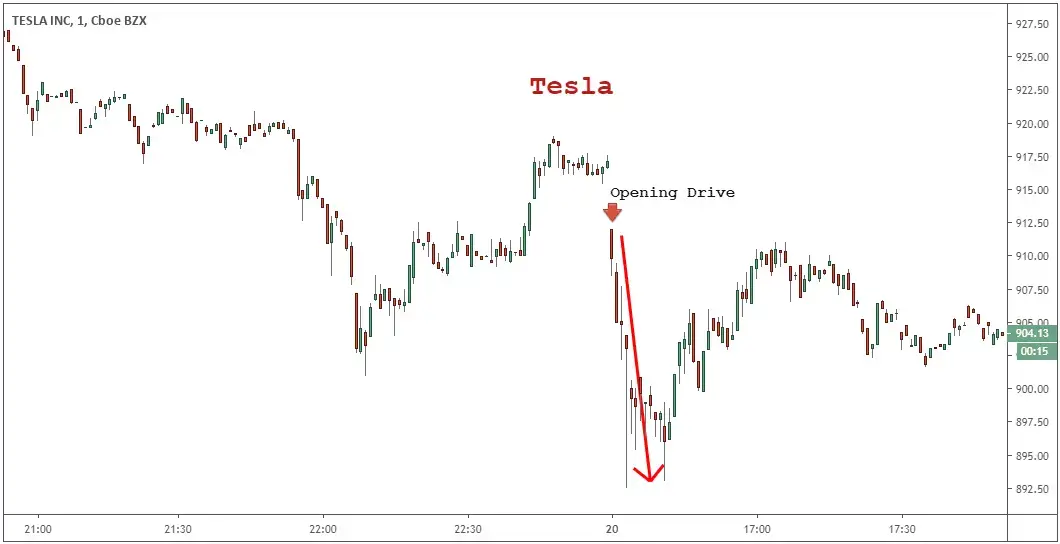
The stock-opening bell drive is the primary component of this single-stock method.
You may be surprised to learn that the ideal time of day to trade stocks is:
- the first hour from 9:30 AM EST to 10:30 AM EST after the opening
- 3:00 PM EST to 4:00 PM EST, the last trading hour before the closing
That being said, we need a strategy to act as a guide in order to capitalize on the opening drive.
Check out the Tesla diagram below:
How should the stock opening drive be framed?
When we trade the opening bell, we believe we are trading with smart money and following institutional order flow.
The massive orders that enter the market at the open have the ability to affect the stock price. Additionally, this may supply us with a one-way price extension. As a result, we hope to benefit from the price change.
This is a chance to learn how to trade inside the first hour of the stock market’s opening bell.
Here are some trading parameters to help you determine when an opening driving opportunity may develop.
Please keep in mind that this is an optional day trading approach. Your ability to properly analyze stock price movement will increase with time.
Step 1: Determine the Directional Bias of the Opening Drive.
The single stock trading method seeks to benefit from a momentum move or the continuation of the initial price gain.
The single-stock trading arrangement works as follows:
The stock price needs to rise or fall first. This filter will decide the direction of our bias. And we decide whether to go long or short based on our directional bias.
- If the stock price rises, we go long.
- If the stock price falls rapidly, we go short.
- We do not have a trade setup if the stock price is jumping about and does not show a clear bias. That day, avoid trading.
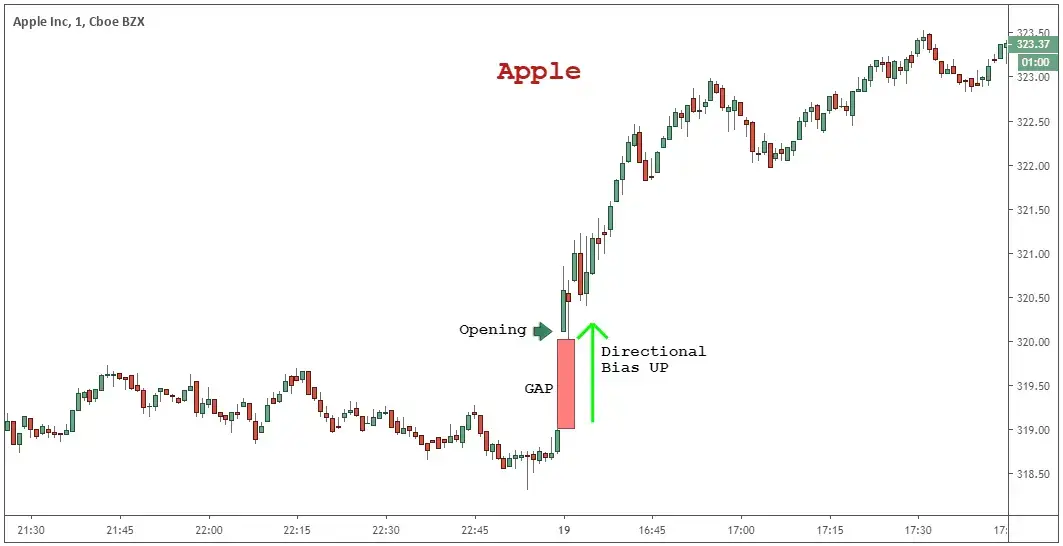
The aforementioned Apple stock chart demonstrates a rapid early rise due to a price disparity.
Therefore, there is an upward bias.
Then.
Let us now set the stock entry’s filters.
View below:
Step 2: Consolidate After Observing the Stock Price Stall Out
Our entry method for the single-stock strategy employs two filters.
We anticipate some consolidation after the initial move in the stock opening. A consolidation happens when the price goes sideways for at least three bars (or three minutes).
Note: We track stock price changes at one-minute intervals.
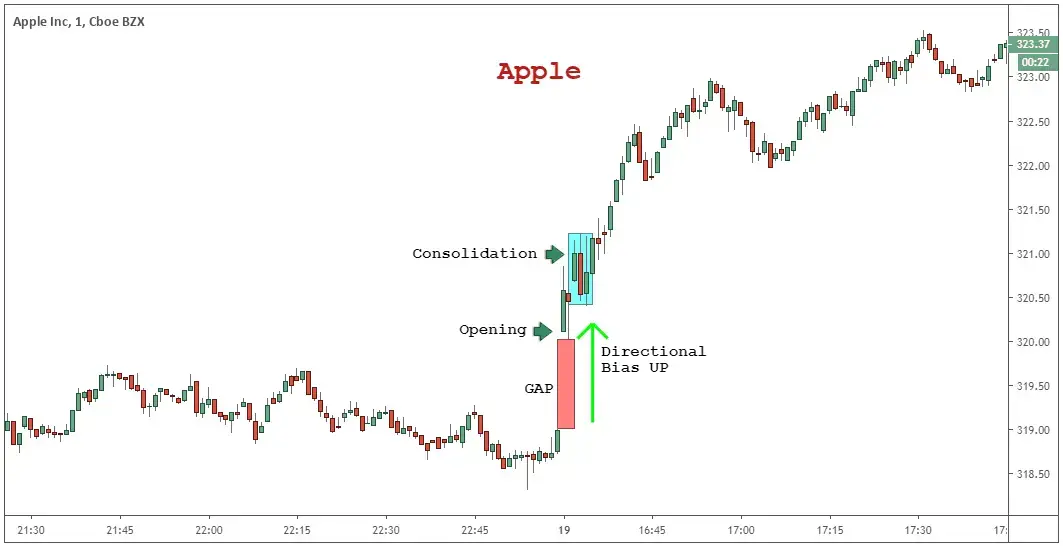
There is one more item to think about.
We want the consolidation to take place above the open price if there is an initial upward momentum surge. Conversely, if the first momentum push is downward, we want the consolidation to take place below the starting price.
However, there are situations when we want to lessen the initial momentum push.
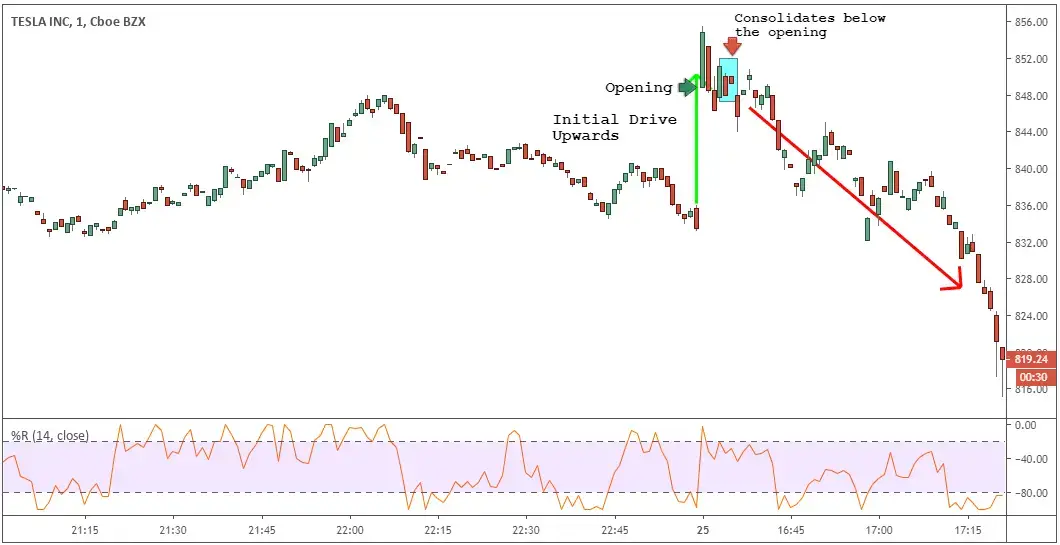
When there is a bigger early momentum push, markets often drop above or below their beginning prices. We must shift our directional bias to the downside, for example, if the market falls back and consolidates below the open following an early upward surge.
This price behavior is shown in the following stock chart example:
Let’s now talk about the factors that influence deciding whether to buy particular stocks.
See below:
Step 3: Purchase if we exceed the top of consolidation.
It makes sense to hold onto the stock during that period and watch its direction.
It would be wise to purchase if there is an upward breakthrough.
Essentially, therefore, we use that consolidation as a roadmap for the entrance.
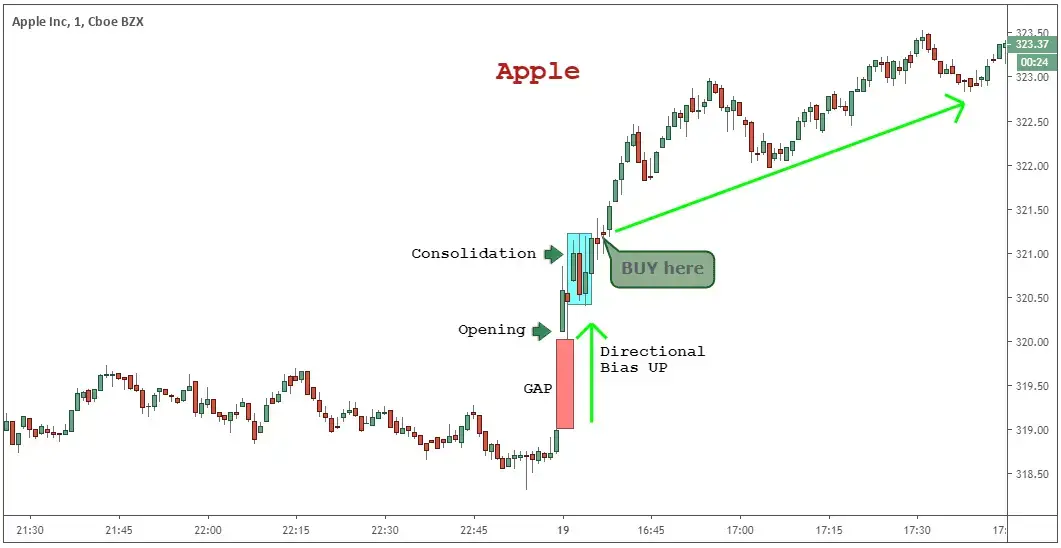
Since we also want to preserve our financial line, the protective stop loss will be concealed two cents below the bottom of consolidation. In addition, the R indicator, which we use to close transactions, shows overbought and oversold values.
When the %R indicator falls from an overbought level, for example, we profit if we buy a single share.
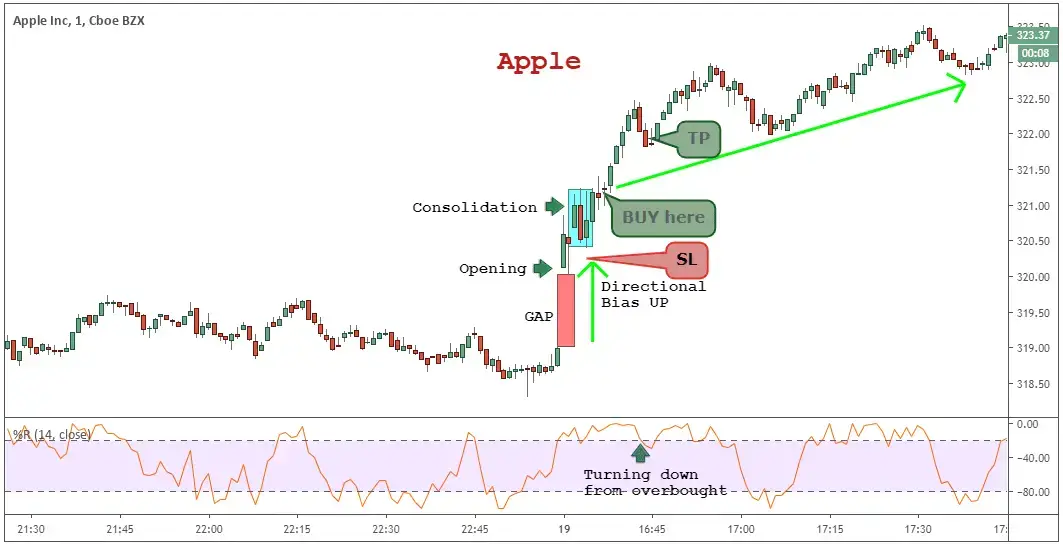
There is a potential that you may miss the trade signal I perceive in my single stock trading approach, so it is discretionary.
However, if you learn to concentrate on and completely grasp just one firm, this stock method has the potential to make you rich.
In Conclusion: Stock Trading Strategy
Finally, experienced traders focus on one thing and become specialists in it. To put it another way, professional traders’ success is largely due to their emphasis on building a single stock trading strategy.
With the single-stock strategy, you can beat the market by trading just what you know best. Professional traders trade because they have a competitive edge.
Anyone may day trade the stock market without spending the whole day glued to a screen, owing to the exciting price action and opportunities that occur from trading in the first hour after the opening bell.
A summary of what you have learned is as follows:
- Being a jack of all trades is not as beneficial as mastering a specific one.
- Become proficient in a volatile and highly liquid stock.
- Prioritize trading during the opening bell momentum spike.
Thanks for reading. Follow for the latest news and information Telegram Channel