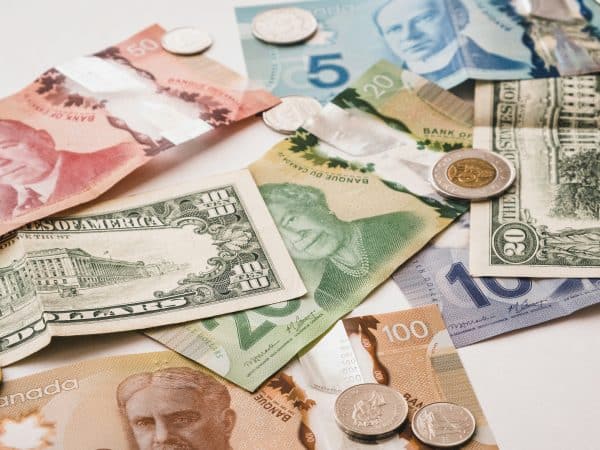

The rate at which one currency is exchanged for another influences international trade and the flow of funds.
Both the value of the native currency and the value of the foreign currency affect the exchange rate.
The USD/EUR exchange rate in July 2022 was 1.02, which means that $1.02 could be used to purchase €1.
KEY POINTS
- The rate at which one currency is traded for another is known as the exchange rate.
- Floating exchange rates are those that fluctuate with market demand and supply.
- In some cases, the value of one currency is used as a benchmark for setting the value of another currency.
- The cost of imported goods and the interest shown in exports will both shift as the value of one currency vs another fluctuates.
Understanding Exchange Rates
Common factors that influence the value of one currency relative to another include the level of economic activity, market interest rates, GDP, and unemployment rate in each country.
Exchange rates, also known as market rates, are determined by the 24-hour currency trading that takes place among banks and other financial organisations around the world.
Rate fluctuations might be minute or massive, occurring every hour or every day. The currency represented by an exchange rate is often abbreviated when quoted.
US Dollar (USD) and Euro (EUR) are two common currency abbreviations. The currency pair between the Euro and the US Dollar is written EUR/USD.
The symbol for the exchange of dollars into Japanese yen is USD/JPY. If the exchange rate is 100, then one dollar is equivalent to one hundred yen.
Base Currency: What it is and a few examples
Reasons for Exchange Rates Fluctuations
Both floating and fixed exchange rates exist. Changes in the foreign currency market cause a free-floating exchange rate to fluctuate.
A pegged exchange rate is one in which one currency’s value is set relative to another. The exchange rate between the Hong Kong dollar and the U.S. dollar is fixed at between 7.75 and 7.85.
That’s why the exchange rate between the Hong Kong dollar and the US dollar is predicted to stay within those parameters.
The spot rate of an exchange rate is its cash value at the present moment in time.
A future value for an exchange rate is an estimate of how much the spot rate will increase or decrease relative to the value of the underlying currency.
Values of forward rates can shift when estimates for future interest rates in one country vary from those in another.
A decline in the euro’s value could be caused by speculators buying dollars on the assumption that the eurozone will loosen monetary policy in comparison to the United States.
Seize the opportunity to buy stocks on Libertex today with a 100% bonus and stay connected for upto date updates.
Example of the Exchange Rate
A tourist from the United States who is visiting Germany needs 200 USD worth of Euros.
A tourist’s sell rate is the exchange rate at which they buy local money. Foreign cash is bought back from tourists and converted to the home country’s currency at the buy rate.
With the present rate of 1.05, $200 will get you €190.48.
Dollars multiplied by the current currency rate equals the Euro.
$200 ÷ 1.05 = €190.48
Let’s say €66 remains after the vacation. Euros converted to dollars at today’s currency rate of 1.02 would cost $67.32.
€66 x 1.02 = $67.32
The yen in Japan is valued in a different way. The dollar appears in front of the yen in this scenario, as in USD/JPY.
Dollars multiplied by the current exchange rate equals yen.
At the current exchange rate of 110, a tourist in Japan who had $100 would receive about 11,000.
You just divide the total amount of yen by the current exchange rate to get the equivalent in dollars.
$100 x 110 = ¥11,000.00
or
¥11,000.00/110= $100
Follow for the latest news and information Telegram Channel