There are two primary methods for analysing any investment type: fundamental analysis and technical analysis. This concept applies to forex trading as well. In this article, we’ll focus specifically on forex fundamental analysis, exploring how it shapes long-term trends in currency pairs. Since our trading strategy is trend-orientated, understanding currency fundamentals is essential to our approach.
What Are Investment Classes?
An investment class includes assets like stocks, bonds, commodities, mutual funds, or currencies. For example, if the CEO of a public company announces that the firm will become profitable and expects earnings growth over the next three years, this reflects strong fundamentals. In such a case, the stock is likely to rise, and a long-term trend may develop due to the improving outlook. Similarly, quality leadership can also be considered a positive fundamental factor. As fundamentals strengthen, technical indicators often follow suit, resulting in trend formation.
What Is Forex Fundamental Analysis?
Forex fundamental analysis involves evaluating the economic strength of a specific country or region to determine the outlook for its currency. It focuses on individual currencies, not pairs. Key indicators include economic data releases, news, and statistics, which ultimately feed into interest rate levels and the direction of interest rate policy for each currency.
For example, when evaluating the US Dollar (USD) or Japanese Yen (JPY), a trader would examine central bank decisions, employment data, GDP, inflation rates, and other economic metrics. These data points affect the interest rate outlook — which in turn influences currency strength. The interest rate differential between two currencies plays a crucial role in carry trades. A 3% rate difference, combined with 10x leverage, can result in a 30% return, not accounting for exchange rate movement.
Fundamental vs. Technical Analysis in Forex
Should traders rely on fundamentals or technical indicators in forex? Arguably, neither should be used in isolation. In spot forex trading, you won’t execute trades solely based on fundamentals, and most traditional technical indicators have proven ineffective for consistently making profits.
The most effective strategy is to conduct market-wide trend analysis, such as multiple time frame analysis of 28 currency pairs, with a focus on the individual currencies. Incorporating fundamental insights into this broader trend analysis provides a solid, evidence-based approach.
For instance, we anticipate a sustained uptrend in USD/JPY if the US economy is strong and Japan’s economy is weak. Our system isn’t technical analysis in the conventional sense. It’s trend analysis with a macroeconomic lens. If a currency pair is showing a clear long-term trend, the pattern reflects the economic contrast between the two currencies. Observing these larger trends is, in essence, a shortcut to understanding the underlying fundamentals, often without the need to review detailed economic data.
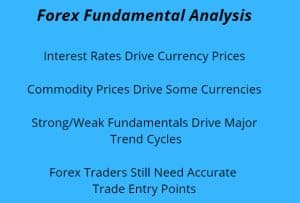
The Dominant Role of Interest Rates
It typically reflects a strong or weak economy, ultimately influencing the currency’s value. A central bank with a solid monetary policy and rising rates is likely to lead to currency appreciation. Conversely, if rates are falling, that currency may weaken.
At Doughvest, we monitor eight major currencies: USD, CAD, EUR, CHF, GBP, JPY, AUD, and NZD. To effectively analyse their fundamentals, you should know the current interest rates and their likely direction for each of these currencies.
Analyzing Commodity-Based Currencies
Currency fundamentals like the Australian dollar (AUD), the New Zealand dollar (NZD), and the Canadian dollar (CAD)—all considered commodity-linked currencies—are
influenced not only by interest rates but also by commodity prices, especially gold and oil.
Australia is a leading gold exporter.
Canada is a major oil and gold producer.
If you expect gold prices to rise, you may consider long positions on AUD or CAD, especially against currencies from economies not driven by commodities (e.g., JPY or GBP).
Similarly, oil price movements significantly affect the Canadian dollar. Canada is a major producer of both oil and gold, which will lengthen the CAD. Conversely, countries that heavily rely on oil imports, such as Japan, may experience a weakening of their currencies when oil prices increase.
Once again, observing long-term trends in commodity-based currencies often reveals these fundamental dynamics — even if you haven’t examined the raw data. For instance, if the Canadian Dollar (CAD) is broadly strong and trending upward, it’s likely that oil prices are also rising.
Japanese Yen Fundamentals and Stock Market Correlation
While the Japanese yen shares typical fundamental drivers with other major currencies, there’s a noteworthy relationship with the S&P 500 index. Generally, when the S&P 500 is trending higher, the yen tends to weaken.
Conversely, countries that heavily rely on oil imports, such as Japan, may experience a weakening of their currencies when oil prices increase. strong, the JPY frequently appears weak on excellent trading opportunities in JPY pairs.
Of course, Japan’s interest rate policy still plays a critical role in driving the yen, but the stock market correlation is a useful additional insight.
Avoid “Analysis Paralysis”
It’s important not to overcomplicate forex fundamental analysis. Because the forex market is highly efficient, price movements quickly reflect most fundamental data. You don’t need to dissect every news release. Simply focus on the major trends — by doing so, you’ll be trading in alignment with the fundamentals.
Overloading yourself with economic details can lead to “paralysis by analysis.”. Instead, focus on identifying broad trends across currencies, and then let the economic news and market sentiment support what the trends are already showing.
Simple But Powerful Use of Fundamentals
To simplify: interest rate direction and forward guidance from central banks provide most of the fundamental insight you’ll need. Over time, interest rate expectations and market trends absorb all other economic news.
Even when trends aren’t clear and the market is ranging, you can still trade effectively using multiple time frame analysis to identify short-term opportunities.
Currency vs. Currency Pair Fundamentals
You cannot analyse the fundamentals of a currency pair like EUR/USD — because fundamentals exist for individual currencies, not combinations. You must assess the euro and the dollar separately.
Regrettably, many traders tend to overly rely on technical indicators applied to pairs, a strategy that often fails to yield the desired results. To increase the likelihood of a successful trade, pair a strong currency with a weak one after performing individual currency analysis. Tools like the Forex Heatmap can support this method not only for analysis but also for trade entries.
Trade Execution Still Matters
Even if fundamentals suggest a long-term direction, you still need a solid entry strategy. Markets can temporarily move against fundamentals or range for extended periods.
Tired of losing trades? Open a Libertex account to start trading stocks and forex with the professionals today.
For instance, a short-term selling opportunity on EUR/AUD can still be a valid trade, even if AUD is showing strong momentum and EUR/AUD is in a long-term uptrend. Take advantage of these shorter moves for daytime or swing trades. The goal is to always maximise pips, regardless of short-term countertrends.
Conclusion: Fundamentals Are Built Into Market Trends
While fundamentals are valuable, you don’t need to master them in detail to be a successful trader. By simply analysing long-term trends across all 28 pairs and evaluating individual currencies, you’re already incorporating fundamental insights into your trading.
Knowing interest rate direction—and, for commodity currencies, monitoring commodity prices—can further enhance your decision-making. But ultimately, you still need a good trade entry system to capitalize on what the market offers.
We hope this simplified guide to forex fundamental analysis enhances your understanding and supports your trading success.You can also read; Essential Difference between Technical and Fundamental Analysis
Thank you for taking the time to read. Follow for the latest news and informationTelegram Channel