

The stock market may seem intimidating to new investors, despite the reality that investing in stocks can be an exciting and profitable method for people to build wealth. These complicated trading systems include a variety of tools, online brokers, and trading platforms. Every day, a big number of rookie traders fail to maximize their market potential due to ignorance, lack of preparation, and inadequate risk management.
Tired of losing trades? Open a Libertex account to start trading stocks and forex with the professionals today.
Anyone may become a successful trader with the appropriate information, mentality, and approach.
Key Point
- Beginner investors should define their trading style before making stock market bets. Individuals’ styles are determined by their personality, risk tolerance, time commitment, and financial aspirations.
- Choose a brokerage that will complement your trading strategy and provide you the tools, resources, and assistance you need.
- Examine possible trade possibilities and use technical and fundamental analysis to inform your judgments.
- Explore the many forms of orders. Knowing the pros, downsides, and workings of each can help you make better trading judgments.
- Clearly describe your risks and stick to your action plan. This requires proper position sizing, diversification, and stop-loss orders.
How To Trade Stocks
Choose the kind of trader you want to be.
Before you start trading, you must first decide on your trading style. Do you like to trade for the short or long term? Would swing or position trading be more suitable for you, or do you lack the time and dedication to be a day trader?
Take into consideration your temperament, risk tolerance, and the amount of time you can devote to trading. This will help you choose a trading strategy that fits your goals and skill level.
If you have limited time for stock market research and are generally risk averse, day trading is not the best solution for you. It is not for the faint of heart, since it requires constant market monitoring throughout trading hours and rapid decision-making under pressure. Swing and position trading are likely to be more suited due to their lower time commitment and longer holding durations.
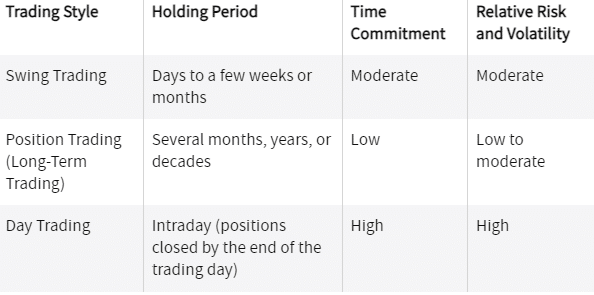
The trading techniques are shown above based on how long a trader or investor holds onto their stocks. To make the fastest transactions, day traders often shut out all of their positions at the conclusion of the trading day. Their objective is to profit on transient price changes.
Swing traders are those that hold onto their holdings for a few days, weeks, or months at a time. They attempt to identify short- to medium-term trends. Even while this method takes less time than day trading, it still requires a high degree of market engagement.2.
The third kind of trading is positional or long-term trading. This is intended for investors who hold their stocks for many months, years, or even decades. With a focus on long-term trends, these investors may make decisions based on both technical and fundamental research. This method requires patience and a long-term view with fewer trading sessions.3.
No trading approach is universally effective. It’s critical to choose a trading strategy that aligns with your personality, level of risk tolerance, and lifestyle.
You may find that your preferred trading technique changes as you gain knowledge and experience, or as events in your life alter.
2 Research Brokers and Choose the Best Fit for You
After deciding on your trading approach, you need to choose a trustworthy online broker and open an account. You’ll want a platform that satisfies your needs. While all brokerages provide a variety of services and tools, some may be more suited for your trading style than others.
Brokers for Investors on the Short Term
A platform with real-time data, quick speeds (low latency), and advanced charting tools is crucial for day traders. These traders often need tools like as Level 2 quotes, which provide detailed liquidity information on the order book, and hot keys for expedited ordering. They could also provide automated or algorithmic trading options, triggers, and technical indicators. Customizable platforms like Think or swim from TD Ameritrade, Interactive Brokers, and Trade Station are popular among day traders.
Brokers for Short-Term Investors
Swing and position traders should look for a platform that offers a wide range of indicators, research tools, basic analytical skills, and risk management features. These traders may also benefit from a platform that offers mobile trading apps, which allow them to monitor their positions and execute trades while on the go.
Many research tools, easy-to-use interfaces, competitive pricing, and commission-free trading on the majority of stocks and exchange-traded funds provided by brokers like Charles Schwab, Fidelity, Robinhood, and E*TRADE may be advantageous to swing and position traders.
Brokerages for Long-Term Investors
The greatest choice for new or seasoned investors is most likely a brokerage with a comprehensive educational department and an intuitive design. Robo-advisors such as Betterment and Wealth front are good options for anyone who would like a more automated approach to managing their investments. These platforms make use of algorithms to create and manage a variety of portfolios based on the goals and risk tolerance of its clients.
Go up online brokers and trading platforms for a more in-depth examination of the best brokerage platforms for different kinds of trading.
Tip: You may practice trading with virtual money utilizing free demo accounts provided by many brokerages before risking your real money.
3) Open a brokerage account and add money to it.
Once you’ve decided which platform best suits your trading needs and preferences, it’s time to create and fund an account. The process is easy to follow and just takes a few minutes to finish.
Provide your personal information: You must provide your birthday, Social Security number, name, and address, among other necessary facts. You cannot get beyond the legal need to verify your identification and thwart fraud, thus you cannot leave by traveling elsewhere.
Choose the kind of account you want to open: Brokers provide a range of account types, such as Roth and traditional IRAs, individual taxable accounts, joint accounts, and more. Select the kind of account that best suits your trading goals and tax situation.
Completely fill out the application: Fill out the application online. Further questions regarding your earnings, wealth, trading background, and employment status could also be included. This helps brokerages stay compliant with regulations and assess your tolerance for risk. The information may also be used when you apply for account features like options and margin (borrowing to trade). It is important that you thoroughly read and accept the brokerage’s terms and conditions, which outline the services offered, associated fees, and your rights and responsibilities as a client.
Add funds to your account: Before you can begin trading, you must deposit money. It may take a few days for the funds to be available for trading once you’ve loaded your account. The financing plan and your brokerage’s policies will dictate how long it takes. Most brokerages provide you many options for funding your account, including:
- Bank transfer: Link your checking or savings account to your account to initiate an ACH transfer. It usually takes a few days for the money to show up in your account.
- Wire transfer: You may send money from your bank account to your brokerage account using a wire transfer to get started trading sooner. Wire transfers usually clear on the same or next business day, however there is always an extra fee.
- The slowest funding method is check deposit, however many brokerages allow you to fund your account by sending a real check.
Ensure that you are informed of any account maintenance fees as well as the minimum balance restrictions. Certain brokerages charge a minimum initial deposit or charge fees if your balance falls below a certain threshold.
Tip: When assessing brokers, compare the commissions, research and analytical skills, usability, and reputation of the best online brokers. Some websites provide online broker reviews to help you choose the best broker.
4 )Examine the Stocks You Wish to Invest in
Before making an investment, you should do some research on the stocks you are considering. This entails examining the fundamentals of the business and the historical movement of the stock price. When the time comes to go in, you’ll feel lot more confident if you combine technical and fundamental analysis.
- Fundamental analysis: Long-term investors and position traders benefit most from this strategy. It entails assessing the competitive landscape, development potential, and financial stability of an organization. Examine the financial documents of each firm to determine its degree of debt, liquidity, and profitability. Seek for businesses that have steadily increasing profits over time, since this may be a sign of a strong company plan and capable leadership. As you reduce the number of possible investments on your list, find out more about the company’s position and industry. Its market share, what is it? Is this an industry that will grow? Remember to look into the management team and history of the organization. The Trading Academy’s “Fundamental Analysis.”
- Technical analysis: Technical analysis is a common tool used by swing and day traders. To find trends and patterns that point to future price movements, this entails analyzing historical pricing and volume data. Consider searching for identifiable chart patterns like wedges, triangles, and head and shoulders. These price patterns may be used to predict future trend reversals or continuations since they show how market players behave. Trends as well as possible levels of support and resistance may be found with the use of moving averages. To determine whether a stock is about to rise or fall, you would use oscillators like the stochastic oscillator and the relative strength index to measure momentum. These technical analysis tools are available on several platforms.
- Sentiment analysis and news: Keep an eye on investor sentiment and news regarding the stocks you are interested in. Examine the earnings reports. Transcripts of earnings calls usually highlight certain issues that investors should be concerned about. Examine analyst ratings, management direction, and any macroeconomic or geopolitical developments that could have an effect on the business or its sector.
- Diversification: As you construct your stock portfolio, it’s critical to make investments across industries, market capitalizations, and geographical areas to reduce risk. The impact of any one underperforming stock or industry is lessened by diversification.
Ongoing education: Increase your understanding by reading books on the stock market, financial articles, and online guides. - Analysis and research are continuous processes. As you acquire expertise and understanding, you may choose to improve your research techniques and create a more customized strategy for choosing stocks. In order to make sure your portfolio is in line with your trading objectives and risk tolerance, it’s also critical to periodically check and evaluate it.
Tip: In-depth research tools and resources are provided by several brokerages to assist you in analyzing stocks and making wise trading selections. They consist of market news, stock screeners, technical and fundamental data, and instructional materials.
5) Place Your Order for Stock Purchases or Sales
Once you have examined a variety of stocks and created a trading strategy, it’s time to place orders with your brokerage. When placing an order, you will need to indicate the kind of order you wish to use, the amount of shares you want to trade, and the stock ticker symbol.
- Market orders are the most basic kind. You request that your brokerage purchase or sell an asset at the best price that is offered. You can be certain that your deal will be completed since market orders are filled promptly. However, you may get a disadvantageous price, particularly if there is a lot of market activity or if the stocks you are dealing with are not commonly traded. When you’re ready to accept the current market price and want to execute a deal fast, market orders are the best option. Limit directives: With these orders, you may specify the lowest price you’re prepared to take when selling a stock or the highest price you’re willing to pay when purchasing one.
- Limit orders increase your control over the price at which your order is executed, but they do not ensure that your order will be completed. If the stock never reaches the price you have set, your order will not be processed. When you are prepared to wait for the market to reach a certain level and have a certain price in mind, these orders might be helpful.
- stop orders: These are placed when a stock hits a certain price, sometimes referred to as the stop price. When the stop price is reached, the order becomes a market order, which is filled at the next available price. In the event that your stock starts to decline, stop orders may shield your gains or restrict trading losses. But in volatile markets, your order can be completed at a price that is far different from your stop price.
- Order Amendments and Cancellations: Before your order is completed, you may be able to change its terms, including the limit price or the amount of shares. But remember that in markets that move quickly, your order can be completed before you have a chance to do so.
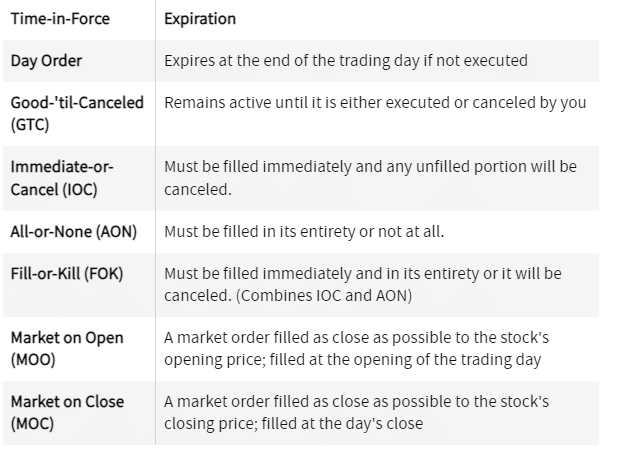
The time that is in effect at the moment you place your purchase must also be specified. It is active for this duration. The most popular alternatives that the top online brokers provide are included in this table, along with their acronyms:
To prevent expensive errors, always double-check the facts before investing. Check to ensure that the order type, amount, price, and, if applicable, stock ticker were submitted correctly. Make sure the amount contains the right number of zeros, since purchasing 1,000 shares costs ten times more than buying 100. Any fees or commissions related with your transactions should be carefully monitored since they may have an impact on your revenues.
6)Risk Management
Once you’re fully functioning and dealing with true financial risk, you’ll need to learn risk management. To reduce the effect of possible risks on your portfolio, you must first identify, appraise, and prioritize them. Effective risk management tactics may help you preserve your hard-earned money, minimize losses, and improve trading success.
- Diversified investing requires owning a range of industries, asset types, and equities. Diversification allows you to reduce the influence of a single investment’s performance on the overall performance of your portfolio. This is particularly essential for long-term investors to remember, although diversification does not guarantee profits or remove the danger of loss.
- Control over emotions: It’s hard to overstate the significance of emotional control in risk management. Fear and greed may have a significant impact on your trading choices. Fear may cause you to abandon a position prematurely, but greed may cause you to stick onto a losing stock long after all hope of a recovery has faded. You may make more careful judgments and prevent impulsive transactions by controlling your emotions and adhering to your trading strategy.
- Hedging: For more experienced traders, hedging means placing money in a position to counter the risks they’re taking with another transaction if the market goes against their expectations. It’s better suited to experienced traders. If you own stock, you should consider purchasing a put option as a hedge against prospective price drops. Hedging is a very effective risk management approach, despite its high cost and complexity.
- Position sizing refers to how many shares or contracts you trade in relation to the size of your account. By selecting the appropriate position size, you may reduce your risk and prevent placing too many eggs in one basket. As a general guideline, never risk more than 1% to 2% of your account on a single transaction.
- The risk-reward ratio measures the prospective profit and loss in a transaction. The usual risk-to-profit ratio is 1:2. If you risk $1, you may make $2. By keeping a positive risk-reward ratio and ensuring that your successful trades outnumber your losing ones, you may increase your total earnings.
- Orders for Stop Losses: These critical risk management tools will automatically exit the position when the stock price hits a certain level. Setting a stop-loss allows you to reduce your potential losses while also protecting your money. When placing an order, take into account the stock’s volatility, levels of support and resistance, and your risk tolerance. A trailing stop is a kind of stop-loss that changes automatically when the stock price increases to your favor. This allows you to lock in earnings while minimizing prospective losses. The trailing stop-loss grows in lockstep with the stock price, keeping a constant distance from the current price. If the stock price reverses and reaches the trailing stop-loss, your trade will be terminated, preserving your winnings.
Risk management is a constant process that needs regular examination and improvement. You may adapt your strategy depending on changes in the economy, your trading abilities, and your personal circumstances. Risk management is critical for protecting your investment, reducing losses, and increasing your prospects of long-term success.
Are there any significant differences between trading and investing?
Investors often participate in the market for the long term, buying and holding stocks. Traders are boosting their share buying and sells in an effort to generate rapid gains.
Which are the most common trading approaches?
Following the trend might include making purchases when the market is rising and short sells when it is falling. Other popular tactics include news trading, scalping, and contrarian trading, which involves opposing the majority.
Which is better for trading, technical or fundamental analysis?
Because technical analysis has a shorter-term perspective, it is often more appropriate for trading than fundamental study. Technical analysis, which looks at the large picture, may help you discover short-term trends and patterns in trading.
What characteristics contribute to trader success?
Expertise and experience are valuable, but so are mental fortitude and discipline. You need discipline since it’s usually best to stick to your trading approach when things become difficult. Without it, little losses might escalate into huge ones.
In the trading sector, great mental fortitude is required to recover from unavoidable losses and bad trading sessions.
Trading acumen is another crucial attribute for success that may be gained with practice.
In Conclusion,
Before beginning your trading career, learn about the financial markets. Review the company’s financial statements, charts, and pricing to see whether it meets your expectations. Use demo accounts to test these trading methods. Once the findings have been examined, make any necessary changes. Following that, you may study stocks and choose a brokerage to conduct your first transactions. That is not the conclusion of your financial journey; rather, it marks the beginning. You can also read; Margin Stacking: Maximizing Buying Power and Risk Management in Investment Trading
Thank you for taking the time to read. Follow for the latest news and informationTelegram Channel



