

Hello, traders! The subject of today’s article is Forex Scaling In and Out. This money management plan is an advanced method for increasing profits while reducing losses.
In other words, the frequency with which a Forex trader wins or loses is irrelevant. What matters is the difference between a trader’s profit from successful deals and his loss from losing ones.
Introduction
Scaling is an undervalued approach of managing money in forex. Scaling in trading refers to raising or lowering the size of your position during a transaction.
Scaling In
When you scale into a trade, you steadily increase the size of your position as the transaction progressed. If the trade continues to go in your favor, a snowball effect occurs, allowing you to greatly increase your gains.
Scaling Out
The opposite of scaling in is scaling out of a transaction. As the trade progresses, you maintain your trust in it while sometimes taking profits to reward yourself with a virtual “payday.”
These are only the most basic causes for Forex trading scaling in and out. Don’t forget to join us as we look at several scaling options.
Scaling in and out of Forex transactions may be beneficial for traders looking to optimize potential earnings.
Options For Scaling In And Out In Forex Trades
A Forex trader has several options for scaling in and out. Let’s look at some of them.
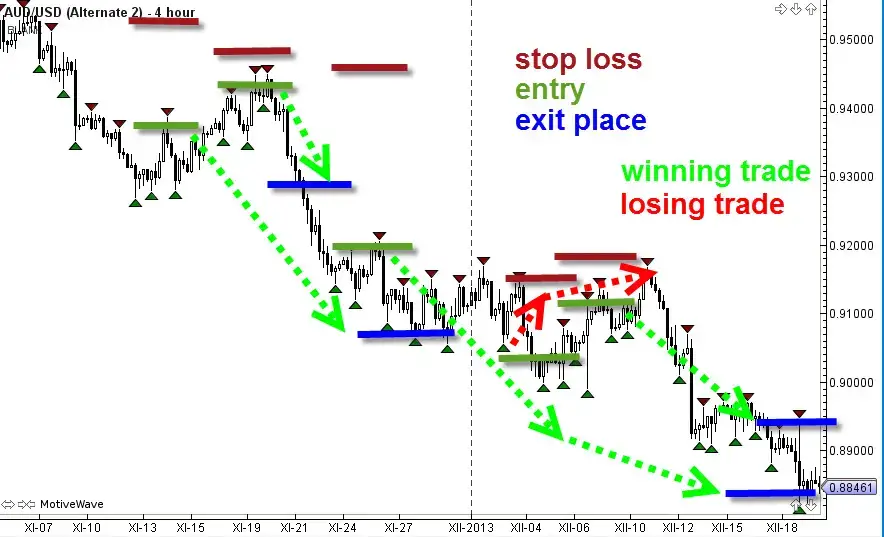
The scaling in money management technique means the Forex trader decides to open multiple positions at (predetermined) different price levels. In the standard situation, a Forex trader makes one trade. However, when scaling in, a forex trader divides the entries into multiple parts.
Investing In Forex Scaling
Scaling in the money management technique refers to a Forex trader’s choice to open many positions at (predetermined) different price levels. A forex trader typically executes one transaction. When scaling in, a forex trader divides the entry into many sections.
There are several sites where entries may be provided. Traders always have the following options:
- Trade instantly.
- Trade as soon as the breakout begins.
- Trade the pullback.
When scaled, the trading decision tree looks like this:
- Trade immediately, grow your position with a retreat, trade on a breakout, etc.
- Trade at the initial breakout, scale in at the second, or retreat accordingly.
- Trade during a retreat, raise your position after a rebound or a second pullback, and so on.
Naturally, the Forex trader has the option of splitting several positions during each pullback and/or breakthrough. During a price retracement, forex traders may enter at both the 50% and 61.8% Fibs, according to the Fibonacci retracement tool.
To complete the various entries, one may utilize a combination of patterns, tools, and hints. A full description of the Forex strategy is beyond the scope of this article. This is an example of a master candle arrangement.
Reducing Your Forex Trading
When a Forex trader scales out, it means that they have decided to close out of particular positions at predetermined price levels. In the usual arrangement, a Forex trader exits a transaction at a single place.
A forex trader divides the exits into many portions when scaling. We address this, for example, in the mysteries of taking gains, where we blend trail stops, soft profit zones, and/or take profit levels.
This scaling-out approach is compatible with the trail-stop, take-profit, and stop-loss methods. A forex trader may choose to use a tight stop loss on one section of the position and a loose stop loss on the other.
Furthermore, traders may designate a piece of their position to a tight take profit and another to a wide take profit. The trader is responsible for ensuring that the overall transaction and each individual trade have an appropriate reward-to-risk ratio. The potential for expansion may rapidly develop and expand.
Scaling Out Example: It seems reasonable that forex traders would be hesitant to give up a profit while they are in the black. Traders frequently use a trailing stop to protect their transactions from significant swings.
Alternatively, they might scale their trade by splitting it in half and profiting on half of it with a reward-to-risk ratio of 1:1. For the second segment, they may aim for a higher take profit while preserving the stop loss at its original position.
In this way, when the price hits the first target, the risk is reduced to zero, enabling the other half to aim higher. Actually, both ways are useful; it all depends on the trading personality of the individual and the methodology used.
We merely want you to know that you have options. Both may achieve the same goal. We are all aiming to exercise smart money management, which promotes both a trading attitude and profitability.
Tired of losing trades? Open a Libertex account to start trading stocks and forex with the professionals today.
It’s vital to note that you can’t use both tactics simultaneously! A Forex trader may apply the same amount of profit-taking while scaling in. Another alternative for a Forex trader is to initiate the transaction at the same price level and then exit it utilizing a scaling-out method.
Throughout the trading strategy, the tactics may alter.
A planned breakout scale-in, as defined in a trading strategy, may be canceled under certain conditions. A scheduled trade exit may be amended at a specific moment.
Advantages of Scaling In and Out of Forex Trades
The following are some advantages of scaling in and out:
- Minimizing losses when they arise.
- Allowing huge winnings when victorious.
- A larger position size results from a higher average price.
- Perhaps earning a profit by, say, scaling out and then back in during a slump.
- Having a trading approach that allows for flexible market interaction.
- The strategy reduces overall risk while increasing potential return.
Disadvantages of Scaling In and Out forex trades Scaling
Scaling in and out of transactions has many disadvantages, including the following:
- Trade administration has become more complicated, requiring more time and attention.
- It is essential to avoid employing this method at all costs since it might have severe results if applied incorrectly or outside of the trading strategy.
- To ensure that the technique is followed properly, forex trading must be quite safe.
- Winning trades may win little, while losing trades may lose more if not all entries are triggered.
scaling In and Out the execution of trades
There’s no question that using this strategy in real life is essential. Mastery of a skill, like anything else in life, demands consistent practice. The most effective way to learn is with a mentor.
At Doughvest, we utilize a strategy known as the “Double Trend Trap” approach in our Forex trading room. This technique uses two unique methods: a pullback approach known as boomerang and a breakout strategy known as strike.
A Forex trader may automatically scale in and out utilizing the strike and boomerang method by simply following the Double Trend Trap’s (DTT) principles and suggestions. Having clear norms and principles makes learning how to implement this money management plan much simpler.
Rules for Scaling In and Out of Trades
Some Forex traders may worry if it is wrong to add to a losing position. If the add-on is determined on the spur of the moment, the answer is undoubtedly yes. In this case, the forex trader is increasing the risk associated with his open and exposed positions. This tactic is appropriate, however, provided the scale-in is planned and the additional trade positions are part of a bigger trading strategy.
In this case, adding a position doesn’t increase the overall risk. The Forex trader must follow these steps:
- The forex trader determines the total trading risk percentage.
- FX traders determine the total number of positions in a transaction.
- For each position, forex traders choose an entry, stop-loss, and take-profit method.
- The number of positions that the forex trader holds distributes the entire risk.
- A forex trader sets the size of each trading position.
For example:
A forex trader accepts a one percent risk.
Choose three places.
Different Roles:
- SL bottom/top, TP -618, and 1 position at 50% Fibonacci retracement retreat are the targets.
- first position at TP-618, SL bottom/top, and 61.8% Fibonacci retracement retreat.
- One position at the bottom/top of the Fibonacci retracement is at 78.6%, and the TP is at -618.
has a 1% overall risk across the three positions:
For every 50% Fib, a forex trader risks 0.2%.
Trading forex has a 0.35% risk at the 61.8% Fib.
Trading forex has a 0.45% risk at 78.6% Fib.
The forex trader sets the size of their positions.
The position size will be reduced in this circumstance since 50% Fib has the greatest stop loss and the lowest risk. 78.6% will have the greatest position size due to the highest risk percentage and the narrowest position size.
In Conclusion,
The scaling in and out method may be a highly useful component of Forex trading if the concepts are well-researched, well-planned, and incorporated in the best trading plan—or a trading plan for beginners.
In forex, do you use scaling in and scaling out? If so, explain why. Why, if not? How have you implemented this money- and trade-management strategy?
Thank you for taking the time to read. Follow for the latest news and information Telegram Channel



