

Swing and day traders now have access to additional speculative opportunities through derivatives trading. Derivatives include cryptocurrencies, equities, bonds, gold, oil, and other underlying assets. These assets “derive” the value of these instruments. Rest assured, at the end of this article, we will have cleared up any misunderstanding you may have.
Just keep in mind that trading derivatives may result in huge financial gains or losses. This beginner’s introduction to derivatives trading will teach you what derivatives are, how to trade them, and how to identify the many types.
What is derivative trading?
As the name suggests, derivative instruments are financial products whose value is dependent on an underlying asset. The underlying asset may be any of the following:
- Shares
- Commodities
- Bonds
- Currencies
- Stock Indices
- Or any asset
The most common underlying instruments are stocks, bonds, commodities, currencies, and stock indices. Investors in derivatives do not buy the underlying asset. Rather, they maintain a misleading position.
A derivative contract is simply any security whose value is dependent on another asset. The underlying asset is what determines a derivative’s value.
The most crucial concept to comprehend is that the value of another entity determines the value of a derivative contract.
To help you comprehend, let me provide an example from the actual world. Individuals are unknowingly using derivatives. Derivatives are typically defined as agreements between two parties.
For example, you want to buy a special edition automobile, but the waiting list requires a $10,000 deposit. The waiting list is closed since the vehicle will not be delivered for another year and all of the automobiles that will be produced have already been sold.
If you decide you no longer want the car, you may offer other buyers their space in line. If you can agree to sell your space in line for a greater price of $11,000 to a car fanatic who missed out, he will be unable to acquire the vehicle otherwise. Rather than purchasing the automobile completely, traders purchase an asset whose value is tied to the vehicle.
This transaction is mostly a derivative trade, namely a call option. Trading options is equivalent to paying a $10,000 premium to be first in line for something that will arrive later.
Categories of Derivative Instruments
Five major types of derivative contracts may be distinguished:
- Futures
- Forwards
- Options
- Swaps
- CFDs (Contract for Difference)
As a professional trader, you have access to a wide variety of derivatives. They are all different from one another. With derivatives, you may speculate on future prices, manage risk, and use a variety of trading strategies.
The primary categories of derivatives are outlined in detail below:
1. Forward Contract: Forward contracts, which are standardized contracts, may let derivative traders buy and sell assets later. Because there is no formal agreement or set price, they deal over the counter. The fundamental benefit of a forward contract is that it may help lock in an asset’s future price. As a result, it’s an effective tool for mitigating the risk of a negative movement. Forwards are increasingly frequent on the foreign exchange market.
2. Future contracts: Forward and future contracts are similar. Futures are financial contracts that allow you to buy and sell an asset at a preset price. The fundamental contrast is that futures are exchange-traded derivatives rather than OTC securities. Futures contracts lock in the price of the underlying asset, which is a good thing. Future contract examples include E-mini, CL, GLD, and ZN.
3. Option contracts: Financial contracts known as “options” allow investors to buy (call options) or sell the underlying asset. Under each option contract, the option holder must exercise their option within a specific timeframe. The strike price is an additional, predefined cost connected with options.
4. Swap contracts: Customized OTC contracts, known as swap contracts, are not generally available to average investors. Swaps are financial agreements that allow you to trade one asset for another. Swaps lower the cost of borrowing money. Interest rate swaps are the most prevalent kind of swap.
5. CFDs: CFDs allow small-account individual traders to anticipate the rise and fall of global asset prices. CFDs provide a wide range of trading possibilities, including commodities, equities, foreign exchange pairs, indices, and other assets. See also: Is it illegal for US traders to trade CFDs?
How can trading derivatives be profitable?
Leverage is the major benefit of trading derivatives. This means that you may trade on margin while utilizing just a small portion of the total amount traded as collateral. For speculators, derivatives opened up new chances.
Derivative contracts allow you to speculate on nearly any security. Furthermore, you will be able to own a piece of expensive property that would otherwise be unavailable.
The capacity to mitigate price risk is the second advantage of utilizing futures contracts. Essentially, it allows savvy investors to hedge their cash market assets.
Hedging tactics may help reduce the risk of negative price movements. Derivatives may be used to minimize uncertainty when there are distinct significant risk events, such as earnings releases, that you do not know how they will turn out.
For example, if a derivatives trader is long the S&P 500 index and wants to hedge against risk aversion, he can buy put options on the index’s futures. A put option allows the buyer to sell a certain amount of the S&P 500 at a specified price within a defined time frame. This reduces the trader’s risk in the original position.
Using derivatives, you may shift market risk from risk-averse investors to those who are willing to take on more risk.
Exchange-traded derivatives have another advantage: increased liquidity. This indicates that you may join and leave agreements quickly without affecting the market price. Narrow bid-ask spreads are also a result of high liquidity. As a consequence, you will have cheaper transaction costs than in the cash market.
The next paragraph provides detailed instructions on where to buy and sell derivative instruments.
Where are stock derivatives traded?
Stock derivatives can be bought or sold in two places:
Over the Counter Market OTC.
Exchange-based.
OTC derivatives are basically transacted directly between two parties outside of the exchange. The OTC derivatives market is estimated to be worth more than $1.2 quadrillion. Investment banks are very interested in OTC derivatives.
The drawback of over-the-counter derivatives is that they are unregulated, private transactions between the two parties.
Contracts listed on an exchange, such as the Chicago Mercantile Exchange (CBOE), are referred to as exchange-traded derivatives. The CME Group is the biggest derivatives exchange. Standardized contracts are available via exchange-based instruments known as stock derivatives. Over-the-counter derivatives have counterparty risk, which exchange-traded contracts avoid.
Tired of losing trades? Open a Libertex account to start trading stocks and forex with the professionals today.
Small investors often trade derivatives on exchanges, but institutional traders generally buy them over the counter (OTC).
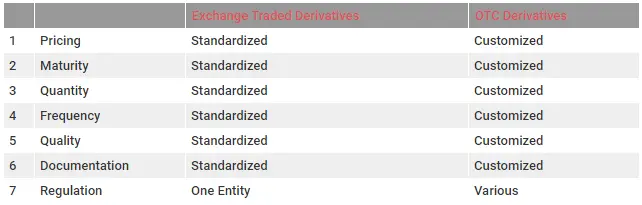
The figure below outlines the key differences between over-the-counter and exchange-traded derivatives:
How Stock Market Derivatives Operate
Derivatives operate as follows:
Hedging or speculating
The most popular exchange-traded derivatives are stock derivatives, namely options. An option on stocks is fairly straightforward. Stock options allow you to buy (call) or sell (put) stocks at a certain price and date in the future.
If Apple stock is trading at $150 per share, for example, the buyer of a call option would be able to acquire Apple shares for $160 at any time between the purchase of the call option contract and its expiration date.
If Apple stock’s price rises during the one-month term, the option holder will benefit. One may purchase options at the current price, above it, or below it.
If Apple’s stock trades at $180 per share in a month, the option holder may purchase it at a discount to the market price. However, now that the contract’s value has grown, the option buyer may sell it on the open market for a bigger profit.
Since the underlying stock determines a stock option’s value, it is a derivative. Find out how to paper trade options.
We’ll cover the foundations of how derivatives work in the real world.
For example, Joe, the farmer, grows wheat every year. He is unsure what the final price will be when the crop is ready for harvest since he grows wheat and is focused on the spot price of wheat.
Farmer Joe is constantly at risk since he has no means of knowing whether he will earn a profit. Derivative contracts are commonly employed in agriculture due to their ability to anticipate prices.
Is it feasible to limit or protect against the risk of volatile wheat prices? Derivatives are beneficial in this case. Farmer Joe may be able to reach an agreement to minimize uncertainty around wheat prices by leveraging the futures markets.

For example, farmer Joe may contract to supply 100 bushels of wheat at a certain price and time in the future. By doing this, farmer Joe is able to better manage his business and reduce some of the risk associated with changing wheat prices.
Farmer Joe now has the liquidity to sell his 100 bushels of wheat owing to speculative activity in the derivatives market. In exchange for the potential profit that derivatives offer, speculators play a significant role in supplying the market with much-needed liquidity.
Conclusions on Derivatives Trading
To put it simply, all well-known and successful investors use derivatives trading as a technique for speculative objectives, whether to increase portfolio risk or boost performance.
However, derivatives, like every other kind of investment, have two sides. Before utilizing stock derivatives, be sure you understand how they work. Once you’ve gathered the essential information and assessed the risk, exchange-traded derivatives should be the obvious option.
Exchange-traded derivatives remain the safest alternative due to their increased transparency and liquidity compared to OTC derivatives. Exchange-traded derivatives are becoming more popular for speculative purposes, so be sure you understand how they work before you invest.
Thanks for reading! Follow for the latest news and information Telegram Channel



