

Introduction
Discover three simple investing strategies that will help you day trade successfully during a recession. In this stock trading video, we will show you how to invest your money during a recession. If you want to survive this or any other stock market crisis, keep an eye on this area for our best stock trading strategy during a recession.
The following three tips will help you withstand a prospective stock market crash:
1. Diversify Your Portfolio Spread Risk
- Spreading assets across a number of asset categories reduces risk (stocks, bonds, commodities, real estate, etc.).
- Sector and Geographical Diversification: To mitigate localized risks, diversify not just across asset classes, but also between sectors and geographical locations.
2. Increase the level of cash reserves
- Maintain cash and cash equivalents as a proportion of your portfolio. This provides you with cash and allows you to take advantage of buying opportunities when prices drop.
- Safety Net: Having cash on hand during a downturn may help pay for living expenses and reduce the need to sell assets at a loss.
3. Protecting Against Downside Risk using
- Options and Inverse ETFs: Use options (such as buying puts) or inverse ETFs to profit from or protect against market declines.
- Safe-Haven Assets: Because safe-haven assets such as gold, silver, and premium bonds often hold or rise in value during market volatility, you may wish to designate a portion of your portfolio to these investments.
During periods of market volatility, you may manage your money more effectively by being educated and devising a well-thought-out plan.
Even if the coronavirus stock market disaster reminds people of the Great Depression and the 1929 crash, it also provides an opportunity to acquire low-cost stocks. Most shares will lose value when the market experiences a recession, regardless of how strong their fundamentals are.
That is excellent news, however.
Stock prices fall following a market crash, making this an excellent time to buy stocks at a discount. Thus, it is possible to make money amid a recession.
Reading this trading post will teach you how to choose the best stock investing strategy during a recession.
A Stock Market Recession: What Is It?
A stock market recession is defined as a severe slowdown in GDP growth. According to macroeconomic theory, a technical recession occurs when the GDP growth rate is negative for two quarters or six months consecutively.
Another way to define a recession is a drop in confidence, investment, and output.
You could be questioning yourself now:
Why does the economy go into a recession?
Recessions are caused by a variety economic factors, including:
Factors such as fiscal and monetary policy changes, increased taxes, and asset class decreases might be internal or external.
In a recession, where should I invest my money?
Examining historical data is the cornerstone of successful stock market crashes and other investment endeavors.
Here’s a stock trading hint:
Check out which stocks have done well in prior recessions.
In this activity, we will examine the equities that saw tremendous gains during the 2008 financial crisis.
In 2008, the US stock market saw a nearly 40% decline in value due to the subprime mortgage crisis. However, certain robust stocks managed to weather the storm even during those gloomy days when other equities fell.
1.Recession-resistant Stocks: A discount Store Sector
Purchasing merchandise from discount merchants is the first way to profit during a recession.
These are the kind of businesses that prosper during recessions. Sales in the retail discount sector often improve, resulting in increased profitability for businesses. As a consequence, these companies are likely to outperform the rest of the S&P 500.
Here’s a list of retail stocks to monitor during the 2020 recession:
- Dollar General (NYSE: DG) soared more than 60% during the 2008 financial crisis, and the stock has risen by more than 38% since mid-March 2020.
- Walmart (NYSE:WMT): As of this writing, Walmart’s stock has risen by more than 19% from its March low after the COVID-19 outbreak.
- Dollar Tree (DLTR, NYSE) is another recession-proof firm that should weather the current coronavirus bear market, having recovered more than 60% in 2008.
Many biotech and pharmaceutical businesses will likewise withstand the coronavirus storm
2.Recession-resistant Stocks: Healthcare Sector
Despite the 2008 recession, healthcare businesses fared well.
Amgen (NYSE: AMGN), a biotech company, was one of the best-performing stocks in 2008, increasing as much as 24.3% at the year’s conclusion. Amgen’s stock has risen about 24% from its March low, despite the COVID-19 stock market disaster.
Moving ahead…
The second recommendation on where to invest during a recession is as follows.
3.Recession-resistant Stocks: The Delivery Services Sector
With over 3 billion people globally quarantined due to the coronavirus, the home delivery services industry has come to be a critical component of our society.
UPS Inc. and FedEx Corp. are the main courier services in the United States, following in close succession.
It is prudent to pay attention when there is anything the stock market’s history may teach us.
When picking healthy shares for their portfolios, stock investors should start with the names mentioned above.
Moving ahead…
Let’s look at some beneficial recession-proof investing strategies.
View below:
Day-trading during recession
An assessment of the previous six recessions has been completed. According to this study, timing an investment is critical to generating a return. When the market rebounds, investing in the DOW at the right time may bring significant returns. It all comes down to time.
You may be wondering now, however.
“How can a recession be profitable?”
Short selling is the simplest strategy to trade equities during a downturn.
Short selling is one method for profiting from dropping stock prices. Stock day traders may benefit from both rising and decreasing stock prices.
It’s difficult to identify lucrative stocks to own during a recession.
Penny stock trading is another feasible strategy.
Alternatively, investing during a recession may be beneficial if you buy dividend stocks.
Dividend stocks may provide a steady stream of passive income during a recession.
Google Trends is another technique you may use to choose stocks.
To understand more about this topic, please refer to our guide: Strategies for Trading Google Trends: Outperforming the Crowd.
However, day trading is by far the best stock trading strategy during a recession.
During a recession, stock investors generally experience more volatility, which is a day trader’s fantasy. Stock day traders will most certainly continue to experience volatility as long as the coronavirus remains unknown.
High volatility in compared to bull stock markets is one of the primary characteristics of a bear market.
Furthermore, the 2020 bear market is the fastest-moving in history. Volatility seems to change significantly between bull and down markets. As a consequence, market volatility will be very high during the 2020 recession.
Following this new revelation, we will teach day traders how to trade equities during a recession.
View below:
What is the most effective stock trading approach during a recession?
This section will show you how to trade stocks on the day during a recession with complete confidence.
This level of stock market volatility is unmatched since the 1929 crash.
The stock price will see considerable intraday fluctuations as a consequence of the coronavirus-induced volatility. You may therefore learn to profit from both increasing and decreasing stock prices in the current stock market environment.
When trading equities during a recession, one of the most common fallacies is that you only learn how to profit when the markets fall. This is a mistake because short-covering rallies in poor markets may occur suddenly and abruptly, leaving you insolvent.
Tired of losing trades? Open a Libertex account to start trading stocks and forex with the professionals today.
Moving ahead…
We will demonstrate how to benefit from day trading during a recession by using a trading strategy based on Trading Guru Larry Williams’ teachings.
View below:
Choosing the Best Stock Trading Strategy for Day Trading During a Recession
During a recession, day trading may be the fastest way to grow your account.
Day trading allows you to trade both ways:
You may benefit from both big rallies and unfavorable trends.
Larry Williams’ winning method in the Robbins World Cup, a worldwide futures tournament, serves as the cornerstone for our stock day trading approach.
But there’s a twist.
Using Larry’s Smash Day reversal pattern, our team of professionals adapted the guidelines to fit our recession strategy.
Now you may be wondering:
What is Smash Day’s reverse pattern?
Larry Williams describes a smash bar as one with long wicks and strong volatility. The Smash bar trading pattern indicates that prior impulsive behavior may be poised to reverse.
Let me explain.
Candle bars with long wicks should be avoided if the stock price undergoes rapid intraday volatility.
Check out the stock chart below:
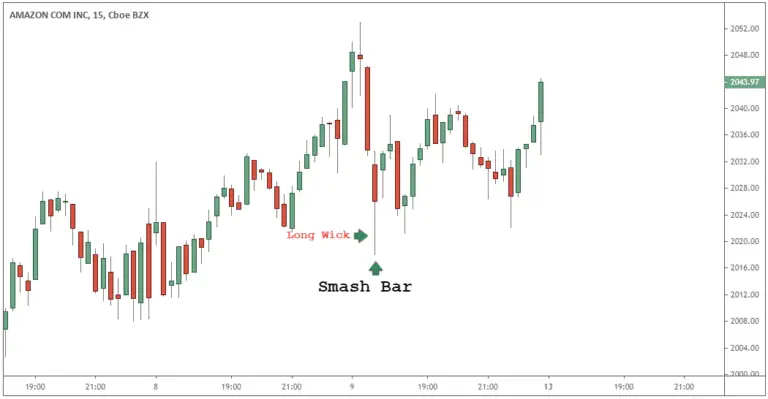
It is critical to differentiate between the normal Pin Bar chart configuration and the Smash Bar trading arrangement. Although the pin bar and smash bar stock chart patterns are similar, the smash bar often has a larger body, whilst the pin bar has a smaller body candle.
When the second candle breaks above the smash candle, the stock reversal pattern ends and a buy signal is created.
View the Amazon stock chart below:
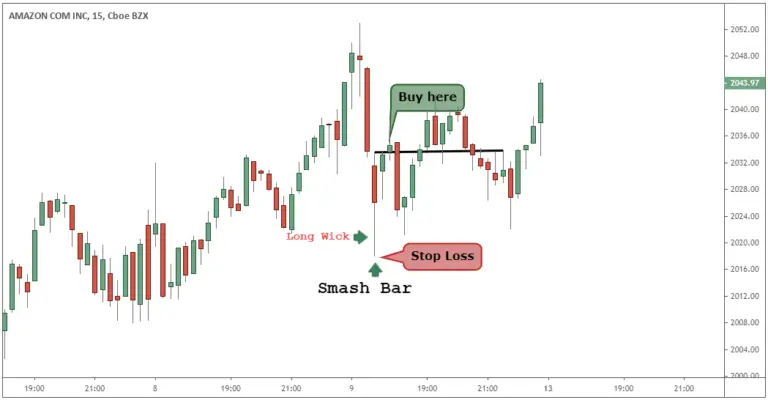
Note* Obviously, the Smash bar’s protective stop loss may be placed at the other end.
Because of the increased volatility, this stock chart pattern is good in attracting new traders. If the subsequent bars move in the other direction, the current stock price’s movement will reverse. This will exacerbate the stock price decline and, ultimately, result in more liquidation.
The coronavirus outbreak has resulted in historically high stock market volatility. This suggests that the Smash bar pattern will appear more often, which is great news. Because market volatility is high during a recession, you may buy and sell stocks. While purchasing stocks has been discussed, how about selling stocks during a recession?
We use the same concepts in reverse.
We may also use a slightly modified version of the Smash bar reversal pattern.
Larry Williams claims to know about a hidden Smash bar.
Allow me to explain:
A sudden appearance of very volatile bars may suggest a market downturn. The closing price of this bar must fall inside the bottom third of the stock price range. Furthermore, it should be bigger than the surrounding bars.
Notably, we will not be depending on long wicks this time.
There is no better way to show how to trade stocks during a recession than by utilizing a price chart.
In Conclusion: Day Trading during recession
If you want to see growth in your account even when the market is down, follow our best day trading during a recession strategy. Learning about stock trading during a recession may keep you risk-aware and help you survive. Finding alternative techniques to protect oneself is critical since the average recession lasts eighteen months.
As an alternative, you may learn how to invest your money wisely during a recession. Investors in stocks may invest in high-quality, recession-proof enterprises such as:
- Discount shop inventory include consumer staples.
- Pharmaceutical Stocks
- Stocks for delivery services or food delivery
If you choose to take risks, day trading the stock market is the best way to benefit from a recession. During a recession, trading stocks utilizing Larry Williams’ Smash Day pattern is a simple but very effective method.
Follow for the latest news and information Telegram Channel